
 |
 |
 |
 |
 |
|

|
 |

Handouts for Participants in the Dorsal Lumbosacral Telecourse with Jan Sultan, Advanced Rolfing Faculty Please print these pages and have them to refer to during your course. Pre-course readings available at:http://www.advanced-trainings.com/sultanreading.html Dorsal Lumbo-Sacro-Iliac Junction Overview: 1. While we use the bones as landmarks to help identify torsional and shearing strains in the body, we must always remember that they are "landmarks" in a sea of soft tissue, and not things unto themselves. So bear in mind, when we identify bony patterns, that bones are passive to soft tissues. The stressors that are arriving at any bony junction are manifestations of distal soft tissue and visceral strains. Often the motion restricted articular pattern is the end point of strain, where the structure cannot adapt. Restoration of the normal motility, mobility. and position of a bone that has "gone out" may ultimately rest on the establishment of system wide Support and Adaptability (those principles again). 2. This means that healing is a system wide event. Local problems are not local. Of course a point trauma; collision, abuse, falls, will have obvious local symptoms. Adaptation to any trauma begins immediately, and the longer it is in the system, the more widely it will be distributed. By and by the feet have to deal with a whiplash, and everything in between yields or shifts a bit to accommodate. 3. This process of adaptation will, by necessity, activate older and previously stable adaptations. Hence the appearance of seemingly unrelated aches and pains emerging in the wake of a traumatic event. This is an expression of adaptive pressure along an "adaptive chain." The real skill in manual therapy rests on keeping the big view while attending to local events. This means knowing that the "symptom" has a context. It is a whole human being. 4. There is a fair amount of argument in the field about the ways and means of the sacrum; the details of axes of motion. There is also firm agreement in some circles about how this works. Again I have to acknowledge the Osteopaths, and their pioneering work in understanding structure. This presentation will outline the two primary types of motion, how they interact, what they tell you about each other, and will open the basic technology of restoration of normal function. The biomechanics of the lumbo sacral region are complex, but not unpredictable. 5. The ratio between the amount of side bending, in relation to rotation, is very individual. Some folks will have more or less rotation than others, in a given sidebend. Allow for this variation in your evaluation. B. The Sacrum: The sacrum is a multi functional junction. Two distinct variables of motion cross the sacrum. One is the cranio-sacral motion, reflective of pressure pulsations in the dura, meninges, and the brain. This is the physiologic motion of the sacrum on the ilium. The other variable is the biomechanical imperative of locomotion. 6. The structure of the sacro iliac junction is like a pair of letter "C's" facing dorsally. The shape of the sacrum is like a letter "C" facing ventrally. The SI joint is synovial, with a capsule, and with a surrounding array of ligaments. The structure of the joint, and the limits of motion in the ligaments, predict and pattern a specific set of movements. Illustration #2 7. When the sacrum rocks its base ventrally, the apex, and the coccyx move dorsally. The apex of the "c" is the point where the horizontal axis of sacral motion occurs. Illustration #3. 8. The physiologic motion of the sacrum is to nutate (from the Latin "to nod) its base anterior and posterior in response to the pressure changes associated with the circulation of cerebro-spinal fluid (CSF). These pressure fluctuations exert force against the dural membranes which line the brain and the spinal cord. The pulsations are rhythmic, about 8-10 a minute. 9. In cranial flexion, as the CSF pressure is rising, the sacral base moves posteriorly between the ilia. In cranial extension, as CSF pressure is falling, the sacral base moves anterior. 10. This pulsation moves around a horizontal axis when the spine is in neutral. Again, neutral is when we are standing on both feet, sitting erect on our tuberosities, or lying down. Illustration #4, 5 
C. The biomechanics of sacral motion: 11. When we put the spine into forward bending, (FB) the sacral base nutates dorsally. In back bending (BB) it nutates anterior. Illustration #6 12. This FB-BB biomechanical response shares the same horizontal axis of motion as the physiologic, pulsatory motion of flexion and extension in the cranio-sacral system. 13. In walking the sacrum is alternately sidebent right and left. When the weight bearing leg in the gait is in the center, the sacrum side bends away from that leg, along with the whole pelvis. Illustration #7 14. The biomechanical sidebend of the sacrum shifts the physiologic axis of motion into a TRANSITORY diagonal axis, TDA. This axis is named for the high side, so in a left sidebend of the sacrum, a right TDA is expressed. This TDA allows the physiologic motion of the sacrum to continue unimpeded as the biomechanical forces cross it. Illustration #8 15. In walking, the sacrum is alternately SB right and left, with the corresponding TDA's alternating. Illustration #9 
16. As the sacrum SB, so it also rotates. The normal biomechanical sacral motion combines side bending and rotation in the same pattern as the lumbar and thoracic vertebrae. Therefore, right side bending of the sacrum couples with left rotation. D. Combined biomechanics of the sacrum and lumbars: 17. This combined motion is similar to that of the CT junction. When the sacrum SB's left, with RR, the lumbars are brought into a RSB, with the vertebral bodies rotating LEFT. The lumbar motion pattern serves to bring the weight of the thorax over the weight bearing leg in the gait. Illustration #10 18. The combined lumbo-sacral motion pattern brings the 5th lumbar into counter rotation to the sacrum with each alternating sidebend. This counter rotation serves to dampen or absorb the biomechanical loads crossing the junction, and to preserve the integrity of the physiologic motion herein. E. Disorders of the Lumbo-sacral junction: 19. Most lumbo sacral problems have their root in FIXATIONS of the transitory diagonal axes (TDA) of the sacrum. When the sacrum, for whatever reason, gets motion restricted into a FIXED Diagonal axis, it restricts the ability of the 5th lumbar to move through its normal motion pattern of SB-R. Sacral R-FDA motion restrictions will pattern the sacrum as if it is in (for example) LSB-RR, its normal response to right leg weight bearing. This means that in left leg weight bearing, the sacrum CANNOT RSB-LR. Illustration #11 20. The lumbars TRY to do their normal pattern of LSB-RR in response to left leg weight bearing, but are limited by the sacral fixation in R-FDA, and its inability to move into L-TDA. This binds the 5th lumbar, and sets it up to receive more than the usual biomechanical loads. Over time, or quite suddenly, the discs of L-5/S-1 and L-4/L-5 are compressed, and may interfere with nerve roots, causing pain, and numbness. Illustration #12 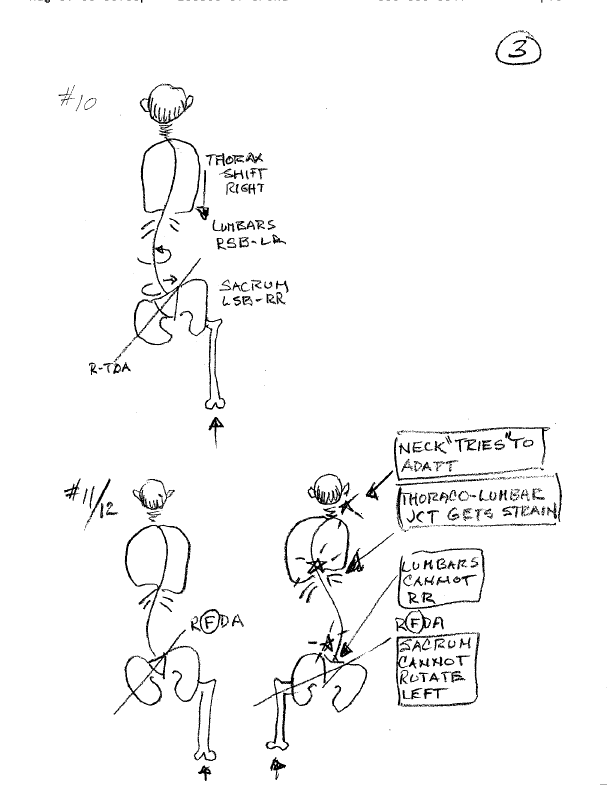
21. ANY lumbar motion restriction must be considered in relation to the sacrum. Sacral FDA patterns must be resolved before the lumbars will operate normally. This is a fundamental that is not well understood by any of the other schools of intervention, particularly the orthopedic/physical therapy view, which holds that the disc is the problem to be addressed. 22. Functionally, when the sacrum is in a R-FDA pattern, with its corresponding LSB_RR, the high and posterior base of the sacrum on the right side is NUTATED posterior, and the left side is NUTATED anterior. Effectively, the posterior base is in its normal response to forward bending of the spine, and the anterior base is in its response to back bending. In this case there will be NO NEUTRAL pattern. Illustration #13 23. This condition sets the stage for the intervention that will correct the FDA, and restore the normal motion to TDA in walking. This correction will allow the sacrum to return to neutral, and will allow the normal physiologic motion to proceed uninhibited by biomechanical restriction. Normal physiologic motion also allows the lumbars to pattern in right and left side bending and counter-rotation, protecting the discs and the nerve outflows. The exercises: 24. Diagnosis of sacral motion restriction is accomplished by palpation. 25. With your client seated, weight bearing on their ischial tuberosities, find the posterior iliac spines (PSIS). These lie under the dimples at either side of the spine, and approximately at the level of the 5th lumbar spinous process. Illustration #14 
26. Having located the PSIS, move just medial, and inferior, to find the level of the sacral base. Remember you are palpating through fat, fascia, muscle, and ligaments to feel the sacrum. You want to feel the depth of the sacrum under the soft tissues, and evaluate the relative depth of the two sides of the sacral base. 27. If you find a deep side, you have a sacrum that is usually sidebent to that side, and rotated away from it. For example, the LSB-RR pattern will have the left base deep, and in its BACK BENDING nutation. The right base will be correspondingly superficial, and in its FORWARD BENDING nutation. 29. To refine your perception, you can have the client back bend while you monitor the sacral response. Typically, the sacrum will not move posterior bilaterally with forward bending, or bilaterally anterior with backbending. It will maintain its FDA pattern throughout the FB-BB test. 30. Intervention consists of putting a pressure on the posterior base, and asking the client to backbend their thorax a bit. As the biomechanical demand for backbending "arrives" at the sacrum, your anterior-inferior pressure encourages the sacrum to go deeper, matching the depth of the deep side, and freeing the motion to go to normal. Illustration #15. 31. You can repeat your palpation in motion after this to see if the sacral base nutates anterior in BB, and posterior in FB signifying a correction. If the BB-FB pattern is normalized, the TDA's will function in walking, and the lumbars will be able to go through their normal SB-R patterns uninhibited .32. The correction described above can also be done with the client lying prone on the table, and performing a "cobra" backbending stretch, while you coax the sacrum to release its posterior base anteriorly into normal BB nutation. Illustration #16 
33. Your homework will be to evaluate every client for normal sacral motion in FB-BB. and treat according to what you find, checking your results with palpation afterwards. If you are successful, your client will report ease of function at the sacrum, and less pain. Long standing restrictions may take a few tries to stabilize the normal movement pattern. When this is coupled with good preparation, particularly in the neck and CT region, you can expect significant improvement in overall function, and perhaps relief from long standing pain patterns.
|
|

 |
Upcoming Events | Consultations | Contact Us | Testimonials | Faculty and Staff | Homepage
Advanced Trainings 3514 Nyland Way South Lafayette, CO 80026 USA
telephone: +1 303/499-8811 x3 email: info@advanced-trainings.com