
The Thinking Practitioner Podcast
w/ Til Luchau & Whitney Lowe
Episode 163: A Master in Plain Sight (with Art Riggs)
Transcript | Subscribe | Comments | ⭑⭑⭑⭑⭑
Or, listen and subscribe on Apple Podcasts, Spotify, wherever you get your podcasts!
🎁 Scroll down for the full video and transcript!
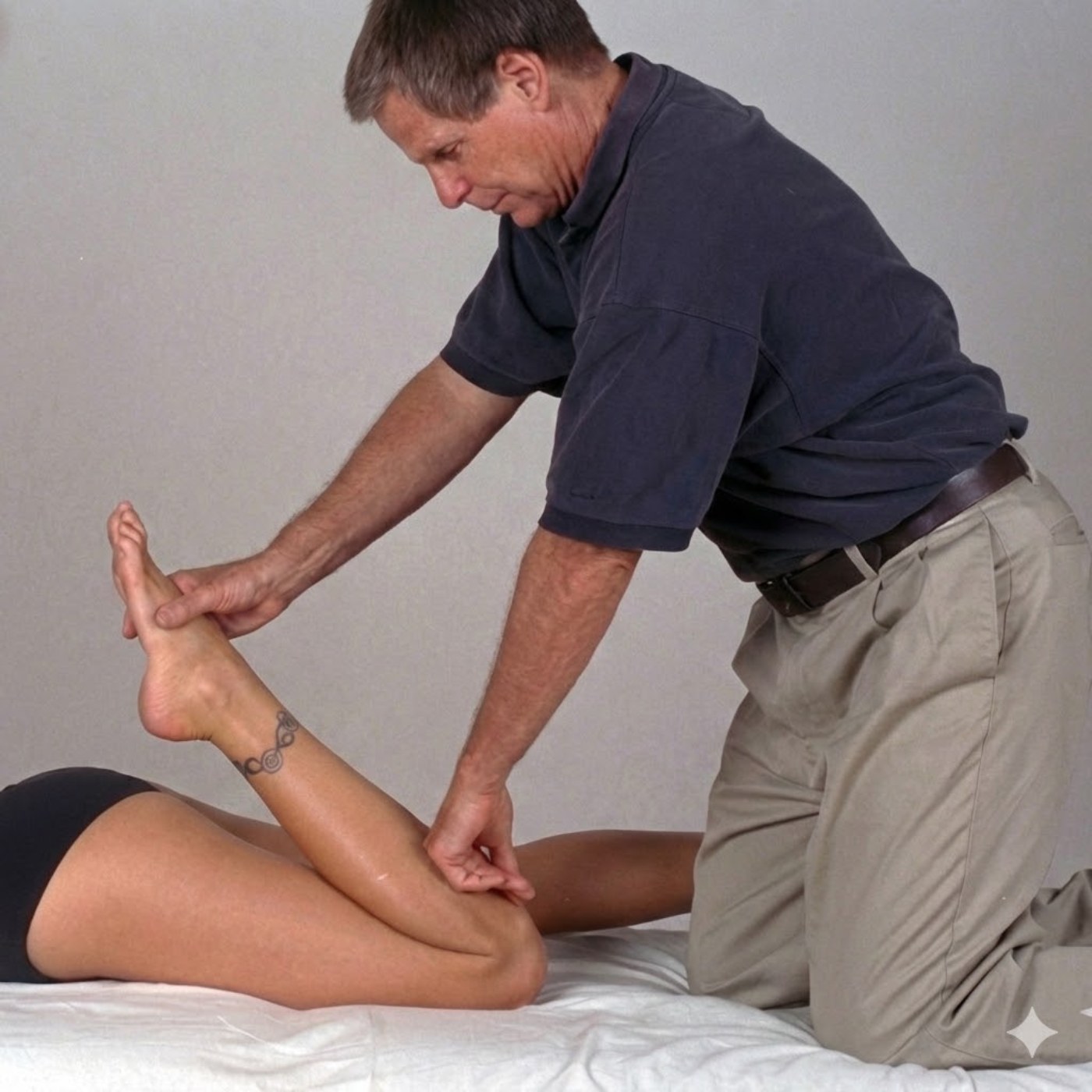
🎙 A Master in Plain Sight (with Art Riggs)
Art Riggs is a Certified Advanced Rolfer™, massage therapist, and creator of some of the most influential instructional video courses in our field. His recordings were among the first truly comprehensive video trainings available to bodyworkers. Decades later, practitioners still return to them again and again, finding new insights each time. They age well because they’re packed with technique, yet grounded in principles that never go out of style.
Here’s the paradox of Art’s work: he shares a staggering wealth of techniques, yet what he emphasizes most isn’t technique at all. It’s listening, allowing, and refining your touch. “Deep tissue,” he explains, isn’t about pressing harder. It’s a conversation with the body, where pressure is just one word in the vocabulary.
At 80, and still seeing clients most days, Art brings warmth and infectious enthusiasm to everything he discusses. He’s humble about his contributions, generous with credit to his teachers, and genuinely delighted by the craft he’s practiced for decades. This conversation is a joy from start to finish.
✨Topics discussed include:
Whether you’re early in your career or decades in, this episode is a masterclass in how to think with your hands.
• Why Art chose “deep tissue massage” over a proprietary name — and why that made his work more accessible
• The difference between deep tissue and “pressing harder”
• Touch as communication: pressure, speed, angle, and reading the body’s response
• “Refine your touch” — the three words that changed everything
• Allowing vs. forcing: offering something for people to take
• Why his first video set covers techniques while his second shows integration into a fluid, full session
• The limits of online learning — and why hands-on classes and receiving work still matter
• The overlap (and differences) between massage therapy and Rolfing® — and what each can learn from the other
• Movement, getting clients off the table, and working in real-world positions (not just neutral on the table)
• The skill of knowing where to work — and when you’re done
• Acknowledging Helen James, who Rolfed until 95: choosing a profession where you can keep learning until you drop
✨ Resources:
• Art Riggs’ video courses (now also eligible for NCBTMB-approved CE): https://advanced-trainings.com/artriggs
• Art Riggs’ book: Deep Tissue Massage, Revised Edition: A Visual Guide to Techniques – https://www.northatlanticbooks.com/shop/deep-tissue-massage-revised-edition/
🌱 Sponsor Offers:
• Books of Discovery – Save 15% with code thinking at https://booksofdiscovery.com/
• ABMP – Save $24 on new membership at https://abmp.com/thinking
• Advanced-Trainings – Try one month free of the A-T Subscription (including lessons from Art Riggs’ courses) at https://a-t.tv/subscriptions/ with code thinking
• Academy of Clinical Massage – Grab Whitney’s free Assessment Cheat Sheet at https://academyofclinicalmassage.com/cheatsheet
✨ Watch the video / connect with us:
• Til Luchau – https://advanced-trainings.com | https://www.youtube.com/@AdvancedTrainings/podcasts | https://facebook.com/advancedtrainings | https://instagram.com/til.luchau
📧 Email us: info@thethinkingpractitioner.com
The Thinking Practitioner Podcast is intended for professional practitioners of manual and movement therapies — bodywork, massage therapy, structural integration, physical therapy, osteopathy, and similar professions. It is not medical or treatment advice.
Rolfing®, Rolfer™, Rolf Movement®, Rolfing Ten-Series™, and the Little Boy Logo are service marks of The Rolf Institute of Structural Integration®, Boulder, CO.

Full Transcript (click me!)
The Thinking Practitioner Podcast:
Episode 163: A Master in Plain Sight (with Art Riggs)
Til Luchau 00:00
The Thinking Practitioner podcast is proudly supported by ABMP, Associated Bodywork and Massage Professionals, the premier association for dedicated massage and bodywork practitioners like you. When you join ABMP, you’re not just getting industry leading liability insurance, you’re gaining practical resources designed to support your career, from free top tier continuing education and quick reference apps like Pocket Pathology and Five Minute Muscles, ABMP equips you with the tools you need to succeed and grow your practice. ABMP is committed to elevating the profession with expert voices, fresh perspectives and invaluable insights through CE courses, the ABMP podcast and Massage and Bodywork Magazine, featuring industry leaders like my co host Whitney Lowe, who is not here today, and myself Til Luchau. Thinking Practitioner listeners like you can get exclusive savings on ABMP membership at abmp.com/thinking Join the best and expect more from your professional association. And today, I am so pleased to be talking with Art Riggs. Art Riggs is a certified Rolfer, massage therapist, and creator of some of the most influential instructional videos in our field. His courses “Deep Tissue Massage and Myofascial Release” and “Deep Tissue Massage and Integrated Full Body Approach” were among the first comprehensive video courses available to body workers back in the DVD era, and they’ve been used by schools worldwide as basis for their courses, but also for entire programs. So we’re excited to be releasing these courses in a new NCBTMB credit-approved format into our subscription and on our own site, and we wanted to sit down and talk with Art about what makes his work so enduring as well as endearing, and why it’s absolutely not just for beginners. Hey, Art, I’m so glad to have the time with you.
Art Riggs 02:13
Hey, it’s great to be back with you Til
Til Luchau 02:16
You’ve been you’ve been here before, but it’s been a while, and I am pleased that you had the time and we could get connected and just hang out together, because it’s always such a pleasure.
Art Riggs 02:26
Yeah, a pleasure for me as well.
Til Luchau 02:29
Let’s talk. I mean, there’s a lot we could talk about. We talked about some in the past, as I mentioned, but let’s talk about these courses. When you first recorded them, there was like, nothing like that available. There was nothing like that around. What was the educational landscape like then? And what gap were you trying to fill?
Art Riggs 02:50
Well, you know, it’s interesting. To be quite honest, I don’t think I was trying to fill any gaps. I really wasn’t too up on on watching videos and things I didn’t really know too much. What was out there? Basically, the gap was requests from people that had read my book or had it in their massage training as their textbook they’d write. And, you know, say some nice things and say why the book
Til Luchau 03:19
is called Deep Tissue Massage and…
Art Riggs 03:23
a Visual Guide. And just a quick one on that, the same thing, I didn’t have any great aspirations. Basically, I’d been teaching at a massage school, and we probably can’t get into it, but there’s so much on learning, and I just saw everybody scribbling notes, because I’m very big on body-positioning and where to place your hands and all that and people were present. They were sitting there writing in their notebooks. So I started taking photos and just did a thing for my class. Somebody gave it to a publisher, and he talked to me about, you know, writing the book, which I did, but then people would say, why don’t you do a video? And I didn’t really feel I was filling many gaps. I hadn’t seen much. Paul St John’s, which, you know, sort of blew me away with all of his information.
Til Luchau 04:13
Neuromuscular therapy..
Art Riggs 04:15
And I saw one video on deep tissue massage, and it was only an hour. I don’t you know it was okay, but you can’t cover that subject in that amount of time. And I thought, well, I could do twice as long, and then I start rambling, and it was a lot longer. I sort of joke with joked in past tense. I’m so sorry to you know, have you know Erik Dalton, who is not with us, but I would, in seriousness, joke with Erik that I quite seriously, would not have even attempted a video if I had seen his first. I would have been too intimidated. You weren’t in the video aspect then when I did, but, you know, the same would go today. If I were starting today, and I’d seen your work, and I’d seen Erik’s, and a lot of other people, I would not have even attempted it, but I’m glad I did. And so I really wasn’t filling a gap
Til Luchau 05:22
I got you, yeah, I think I’m glad you did, too. I remember first seeing your DVDs when I was teaching at the Rolf Institute, and you kindly donated a set to the Rolf Institute. It was actually a radical move on your part, because there were so there was so much culture. There’s so many cultural injunctions against sharing anything as Rolfers or especially those of us teaching there, we weren’t supposed to teach anything or anywhere else. And it was, it was a mind blower for me. It’s like, okay, so here’s a guy, a Rolfer, and I haven’t heard of him, Art Riggs, but he has put all this on recording in an organized, clear, coherent way. And it it certainly opened up my mind. And you know, the field has evolved since then, and the Rolf Institutes worked through some of those injunctions, or is making its peace with them in a way. Butyou were an eye opener for me as well. And I gotta say, I continue to learn things from you. All those years later, we exchanged we got to exchange work. What was it within the last year sometime, I was visiting out in the Bay Area and you gave me a fabulous session that I that, again, opened my eyes in ways like, Oh yeah, you can do that. Sure you can. And I’m using things that I learned in that session with you today.
Art Riggs 06:40
Well, a little bit about the Rolfing. Number one, I am a Rolfer. Particularly back then I still Rolfing is so complex, and I’ve had such fabulous teachers, and I’ve seen all of your work and experienced yours. Same thing. My big thing is touch and when you get your hands on me, within two minutes, I feel things happening in my body that I don’t feel from a lot of bodywork, including Rolfers. So I did work on touch, I would not presuppose to think that I can offer anything in addition to the Rolf training. I’m not a member of the faculty, so I tried to make it a pretty clear distinction that I’m teaching massage, and, just like you, Gil Hedley, Erik, Tom Myers’ people, my Rolf training for the manual skills was totally instrumental, but I don’t try to get into the issues of Structural Integration. That’s where I recommend people to look at you, take the Rolf training, do something like that, because it is so complex. And I’d been teaching at a school, and I just felt it would have been a bit presumptuous to make some sort of deep name for this, and it was deep tissue massage.
Til Luchau 08:11
I want to hear about that in a second, but I do want you’re making me think I had to navigate that distinction between what I was teaching in my general workshops and what I was teaching at the Rolf Institute in very specific and clear ways. And some of you, you’ve always targeted massage therapy, and some of that I’ve seen is your own native humility. And, I gotta say, You said this about Erik Dalton. You said he’s humble, so he doesn’t make the rest of us feel bad. I think maybe you were maybe a little bit talking about Art Riggs, because I find you incredibly humble, and yet what you offer is always so potent and and considered and thoughtful in a way that takes me to the next level all the time.
Art Riggs 08:56
I’m sure glad that I did it. And, you know, I think that the title Deep Tissue Massage made it more accessible. that to therapists. And somebody said, why don’t you put your name on that? And I look at all my fabulous teachers that I still greatly look up to, and I thought I would been pretty presumptuous to put my name to the things that I’ve learned from other people, although I do think I’m pretty experimental. And you know, some of this is just me.
Til Luchau 09:26
So how do you feel about that name? Now, what do you mean by it? And how does like deep tissue differ from just more pressure, pressing harder?
Art Riggs 09:36
Well, that’s a that’s a big one, and, oh gosh, I’ve taught a lot of physical therapists since I stopped teaching at my massage school, more of that. And I actually had physical therapists in Canada say that they’d taken a deep tissue class, and the teacher came back the next day and said they’re not, “getting it”, that she’s not seeing any bruises. and I say that deep tissue massage, a little bit like Structural Integration, has evolved to mean many different things to different people. When Ida titled her work Structural Integration, it was the only work like that. And now there are tons of Structural Integration classes out there that have very different views. I just sort of felt like a lot of people, just at that time, thought deep tissue massage is massage that’s pushing harder, and it is very, very different from that. The amount of pressure you put in there is one factor combined with the speed, the angle, the ability to have a conversation with the body, reading things, as opposed to doing cookie cutter routines. So it’s a conversation, and it isn’t a lecture, it’s it’s a back and forth. And there are many, many roads to Rome, but my approach to deep tissue is that its major goal is to improve function mobility and make people feel good, and so I try to move into things like joint mobilization, particularly working in a non neutral position to challenge restrictions near the end range, and increase end range motion. A lot of differences from the classic start your massage face down half or two thirds of the way through, turn them over, work on each part like it’s sort of a paint by the numbers. And, oh, I’m done with that arm. And you know, that’s the end of that. So even the way I teach and the way I work is very different, depending upon the client that I’m working on and what their goals are.
Til Luchau 12:14
Why do you think your work has remained so popular? This was, this was this was a while ago that you saw me.
Art Riggs 12:22
I don’t know how popular it is, I will say that I don’t really have a website. I’m no longer teaching in the United States. I teach in Europe to take vacations, mostly physical therapists. You know, I’m sort of, I don’t want to denigrate but a little bit of out of vogue now, but I’m some people are still buying it. I think a lot of it, I’m glad that you’re doing this is that I don’t advertise, I don’t write in the in the magazines anymore, like I used to. And I mostly do this to help people. So I’m sort of hoping that some people will go through you, in addition to all of your great work, you know, I think it dovetails with you. I put a little more emphasis upon who biomechanics and touch, but, you know, I’m glad you’re doing this, and hope some people benefit.
Til Luchau 13:22
I see, I’m comparing adding your courses to our library, like being able to, like, add Socrates or Homer or Plato, you wrote the what have become the classics, and they’re and they’re timeless in many ways. And one of the ways is this distinction you’re talking about between deep and listening, and it isn’t very clearly when we see you work in these DVDs or what I’ve been on your table and see you work you’re actually your work is not heavy handed. Your work is very receptive, very listening, and that’s timeless.
Art Riggs 14:00
Maybe, if I could digress a little bit til about the difference between deep tissue and “regular massage” number one, I don’t make a distinction. I would like all “regular massage therapists” to use the same things I’m talking about, even if they’re relaxation-based. The people in my classes feel that they they can come together and give a great massage that people really enjoy and relax and still deal with the problems, you know, that people have. So a couple of different things about touch that I think are important. Is that it is a communication and the depth is one part of our vocabulary, so how hard you press is maybe related to the volume of your speech when you’re talking and how fast you work. Yeah, the people can assimilate the work in with different degrees. So if you’re talking about a complex subject, if the person’s dealing with some really holding patterns, you have to slow down, talk a little slower. Let people conceive of that the speed at which you talk, how loud you talk, being able to tell if the person is talking back to you with their body, with subtle little signs about wanting deeper work, wanting less work, flinching, watching their eyes, things like that, that that the angle that you’re working, what are you trying to do to stabilize joints? So really, it is very complex, and so many particularly early massage trainings are do this, do this, do this, just like I do. And a quick story, not too quick. When I took my first Rolf training, we met the night before, and I’d had really heavy duty Rolfing, which was great. That’s why I became when I became, but I got my I was talking to a woman and fellow student, and I said, let me show you something with the neck, because my Rolfer would get into the neck. And I, you know, it was just amazing. And so I got my hands on her, and within about five seconds, she sort of pulled away, and in a semi nice way, said, “refine your touch”. And it was probably the best thing I’d ever heard, as far as a single way to get better, and that has been my goal for my it’s been 40 years now, I still am refining my touch. When I have your hands on me for five minutes, I can’t wait to get off the table, not because it’s not feeling good. It’s just, oh, I want to try that. I want to try that. And, you know, touch is everything.
Til Luchau 17:07
We share that emphasis you and I, and I’m thinking that we also share the desire to bring massage therapists something that feels satisfying to them as a way that they’re making a significant change. I think that was a driver in a lot of the massage therapists coming to my trainings I’d hear all the time. I want to go beyond what I learned in massage school. I want things that really the client really is involved in or make a lasting change. And interestingly, I trained in craniosacral work first, and then trained at Esalen in various forms of massage and touch therapy there before I ever went to the Rolf Institute, and I, when I got to the Rolf Institute, I would, I would have been that person sitting up saying, “refine your touch” to my fellow students. And I thought there’s so much we could learn here about quality of touch that would improve the client experience and include improve the results. So I think you and I have shared that passion for how we do it,
Art Riggs 18:08
One thing that I say in class, part of what’s my my personality, we I talk to people about their personalities. Some people are too hesitant, they’re afraid to try things. They’re self judgmental, all of that. I grew up working really hard at hard physical labor on summers, played a lot of, you know, pretty heavy duty athletics where, oh, if you’re not doing well, you just try harder. And one of the things I have to keep reminding myself is that I’m offering something for people to take. I’m not forcing it, you know, upon them. And so I try to do a little bit more of, you know, let me see. How would I put this, trying to let things happen rather than make things happen.
Til Luchau 19:06
That might be one of the fundamental principles, maybe the fundamental principle of so many paradigm shifts that came out of the era that you and I cut our teeth in the 70s 80s, and coming out of the 60s, where the emphasis was on allowing rather than forcing, we were working through a lot of our authority issues, you know, left over from previous decades, and we were incorporating Eastern ideas of wholism, as opposed to the linear piece by piece models. So there’s so many paradigm elements there that I see in our shared legacy, that I see coming through in our work here, and yet you’re like, what like the classics your work is, in my mind, really modern in that it keeps emphasizing these fundamental principles that I. I learn from every time, like I watch one of your videos, I learn a trick. I learn an idea like, oh, there’s a cool way to do it. And then I learn a lot about how you’re doing what you do as well.
Art Riggs 20:10
Well, it’s good to say, you know, I go over and over your stuff. And I do have people that just got an email the other day from somebody that five years ago about the videos and said he still keeps at his office and he goes over it, because these things are not something you hear and learn; you incorporate them. I have to constantly put a straight jacket on myself because of my personality, trying to do too much, trying to make things happen. And you know, it’s a fun process.
Til Luchau 20:42
So what has surprised you about what experienced practitioners get out of the material versus newcomers?
Art Riggs 20:50
So that’s a really great question, because I I have great fun teaching people right out of massage school. Lately, the last few years, I think some of the specifics of my videos are of interest. People go on YouTube and they see some of this, and there are physical therapists or something, but I try to make mine accessible to beginning therapists, because that is so rewarding to have people’s eyes open up when they realize what they can do and how much fun it is. And yet, a lot of the physical therapists that I deal with, particularly more in the United States, I’ve been teaching a lot in Poland lately, and their physical therapists take a lot of manual training and a bit of what you you know, sort of mentioned, they take their physical therapy training, which is four years there, do the same stuff we do with anatomy and all of that. They’re much more hands on. They don’t do a lot of ultrasound and EGS and that. They work in private practices, doing a lot of manual work with some strengthening and stretching, you know, exercises, but they take their training and then they go to a simple massage school. And so most of my people, I teach their physical therapists, and I’ll be it’s amazing. It’s surprising that a lot of them, their touch is much less skillful than people getting out of a 500 hour massage class here in the United States, they don’t do touch.
Til Luchau 22:34
It’s interesting to see those differences across different training cultures in different countries. Through the how much emphasis there is in the technical versus the sensing or touch parts. How do you how do you think about that balance in in your viewpoint? How do you balance the intuition or sensing with anatomy, biomechanics, technique?
Art Riggs 22:55
Oh, gosh, you know, that’s so tough. I think it’s one of those things that people just pick up. I i blather along when I’m teaching explain why I’m doing something. It’s not what we’re doing to the body, it’s what what we what we want to accomplish in the body. So, you know, generally, I really want people to experience their intuition and confidence on what they can accomplish, and I think seeing is how to do it. So you can only get so much from a book. And then, if I might, sort of move off a little bit we had talked about the present training now with YouTube and online learning, and you know, it’s great. It’s much better than reading a book. A lot of people can’t take classes. But you know, I’ve come in and I’ve sat in on your classes, and it is so fun for me to step out of that role and go into the learning role, and I just have to say, your classes, I know you said you’re cutting down, and I was sorry to hear that, because I just look at the excitement of the students that are in your class. You’re hobnobbing with other people, you’re feeling their touch, you’re going to the table, and even two minutes on the table of feeling your touch is something you cannot get from a video. So whether it’s you, whether it’s Whitney, tons of other people, I used to sit in on Eric’s trainings, I just have to tell people, take a class. It’s totally different. If you’re not near a class, if you can’t travel, find somebody in your area that is skilled, well known, respected, get sessions from them. You’re right session. You’re right with somebody watching. You hands on personally is as big a jump as videos from reading books, you know? So I’m not doing many classes anymore. I’m enjoying being 80 years old, but I still love when I teach. My main fun is I just, I just look forward to clients every single day. You have a, you know, such a good relationship. And I, you know, I hate to get on the bandwagon, but those of you working in a spa, that’s great. You get your hands on a lot of people. You don’t have to advertise, but the people that I see, the massage therapists that have gone on their own and it takes a while you might work at a spa and then open your own practice. I really would hope people would aspire to working for themselves financially, you start drawing clients that like your work, rather than having strangers come in. So a little bit of a side there. I do try to, you know, really push that on people.
Til Luchau 26:05
You’ve been working many decades, four decades, maybe something like that, then. So are, is there anything you would if you’re making the videos now, anything you would change around longevity, or any shifts you’d make now that you’ve looking back on these decades.
Art Riggs 26:24
You know, I’m always, sometimes my own worst critic. I don’t think so. I think I’ve been very lucky to get in on the early going when I didn’t have much competition, and I see great work out there now. And I do think I have a little, you know, sort of a narrower thing that I’m not trying to be this for everybody, but I do want massage therapists, particularly, to understand what they’re capable of and how much happiness they can get from their work if they’re expressing who they are with good knowledge, rather than doing some routine for 60 minutes. To be honest, 75 minutes is my favorite time. You can overload people with an hour and a half. But I think one of the problems with deep tissue massage is they’re trying to do the whole body in one hour, and you can’t slow down to work on the problem areas, and you rush things. You’re moving too fast. It’s too much for the person to assimilate, and they’re sore because you’re pushing too hard to get the work done.
Til Luchau 27:32
Let’s get specific about that before we wrap it up. Your original set of videos focused on technique in a lot of detail. You cover a big toolbox of techniques, and then in your sequel, you’re followed up with integration and fluid weaving it together. How did you see practitioners struggling between those two things?
Art Riggs 27:54
Great point, and I will mention that great hands are great, but you need you need a knowledge, and you need the techniques. So I think the thing that I did with the length of my videos, each one is over is close to 11 hours long, is you don’t teach somebody to use their knuckles, their elbow, their forearms by showing one technique. So what I do is I apply the touch techniques to what I think are quite a few, I think useful strategies. I started having people say, God, I love this work, but I’m working in a spa, or my clients want a relaxing massage, and there’s sort of a dichotomy of therapists saying, Oh, I don’t do feel good relaxation work. Or, yeah, I don’t do therapeutic work. My view is that you can, you know, really put them together, and particularly if you’re working for longer, you can fix people’s shoulder, low back, plantar fasciitis while working in a very pleasant, you know, situation. So I do show a ton of techniques, but I don’t with the first one, it’s episodic. I’m jumping around playing hopscotch. Here’s here’s your shoulder, here’s your knee, here’s your neck. And then people were writing saying, you know, I’m having trouble.
Til Luchau 29:30
It’s not quite as random as you make it sound. You’re anatomically ordering it, rather than, say, strategically oriented something like that. That’s how I would describe it. Yeah.
Art Riggs 29:40
Well, thanks. So basically, I put together a one way of doing a smooth, integrated massage while still doing therapeutic work, not getting hung up, skipping things. Things I say in class, the skill of massage, number one skill is knowing where to work. Number two, of course, is knowing what to do with that. And one of the other big ones is knowing when you’re done. And that’s a little harder, because it isn’t yes I’m done, the law diminishing return sets in for your timing, you start rushing and other things. And so that’s another one of the skills in doing an integrated massage is, oh, I don’t this person’s fabulous. I don’t need to work on that shoulder. But here I see something when they walk in. First thing I’m doing, I’m looking is that knee moving? Is that ankle moving? Is to prioritize what you’re doing, and it’s as much what what you don’t do as what you do do. That makes a good massage. And when you’re done and when you’re not overworking,
Til Luchau 30:57
What else do you want to leave us with? Art?
Art Riggs 31:00
Oh, gosh, there’s so much I you know, the main thing, main reason I teach it, I like people. I love the students. It’s fun. The biggest problem I see with massage therapists is a little bit like what I had when I got out of the Rolf training and I’d see these master teachers, and I’d look at all the other students that, like you, had a lot more training before they got into this. And I really felt inadequate, and I seriously considered that this might not be the profession for me, that I didn’t think I was very good at it, and yet, my clients were pretty happy. And I just think people need more confidence, particularly in their intuition. They they don’t want, I don’t want people sitting back saying, Oh, I’ve got a full practice, so I have to stop learning, and I’m still learning. And so I would say one of my favorite teachers, Helen James, said she’s so glad she chose a profession where she can keep learning up until she drops. She Rolfed until she was 95 years old, she still lives alone, and works on a farm. And, you know, enjoy your work if you’re not enjoying it, figure out what’s wrong. And a lot of times, it isn’t heaping on more knowledge onto top of what you do know. It’s letting go of concepts that are no longer useful for you. Beginning massage therapist training has to be limited. You don’t want people working on the jugular vein and the scalenes when they’ve had 40 hours of work. But, you know, keep learning and look inside. That’s that’s my biggest thing. I really had to accept the things that are good about my personality. I like people. People. Sense that I’m very interested in people, but I’ve had to really butt heads with a lot of my temperament and some of my ideas that aren’t productive for my work. A couple thoughts just for people, whether you do my videos or not, there’s tons of good ones. I’m not really up into promoting mine, but movement is almost everything. And lying somebody on a table in two positions, in a neutral position, you’re not going to know about their body. I move. I will tell massage therapists work on this. It’s hard. You need communication. The good thing I learned my Rolf training, we worked in under clothes, and I get people off the table. My students, one came to me for a tune up a while back, and I said, are you getting people off the table? And she looked at me sort of confused suit, of course, that’s that’s what my practice is. I have a move, I have a walk. I put them in side-lying positions on the table to work on lumbar, extension and flexion. Be creative and try something if you’re working with intention, trying to get something done, some things aren’t going to work, and you can learn as much from what isn’t working as from what is. And make it fun. If it isn’t fun, decide why it isn’t fun. Is it the money you’re making? Is it the clients you’re seeing that you’re forced to do certain things you don’t you know particularly care for that it’s boring, it should be interesting and fun, and many rows to roam in that you have to look at your own personality,
Til Luchau 34:54
Words of wisdom and Art thank you for being such an inspiration in all those areas and a living again. Example of the fun of the finding the essential and letting go of the rest, and of the love for the work itself. And thanks for taking the time to share the story and the thinking behind your work. And for now, for making it available for like, a whole bunch of new people. In this way, we’re going to have links to in the show notes to your courses, and then to your seminal book, deep tissue massage, a visual guide to techniques, right?
Art Riggs 35:29
I do tell people, they come back and they want to take classes again and again for me, and I say, go see somebody else, you know, add to it, you know, my model for the second video had basic cookie cutter massage training, and I have to admit that it really helped her, particularly stay focused and everything. But she at my telling her she’s seen several of your workshops, gone to them, sat in on them. She came to Eric Dalton’s trainings twice. She’s seen a few other people that I said, check them out. You know, you’ve the law of diminishing returns have set in for what I can tell you, and you know, always keep your eyes open, but do what interests you. There you go. Try to make your work fit into your clientele, like the movie with Kevin Costner. Field of Dreams. Build it and they will come. So do the work that you love. And it may take a while, but that’s the way to do it.
Til Luchau 36:39
Love it. I’m gonna wrap it up with our sponsor, a
Art Riggs 36:43
lot of laughing on my part. So great seeing you til I hope to see you soon.
Til Luchau 36:47
Yeah, hang out with for the sponsor announcements, and then I’m gonna say goodbye to you. So our in house sponsor is Advanced-Trainings, and I’m really excited to announce the that both of Art Riggs, landmark video courses, Deep Tissue Massage and Myofascial Release and deep tissue massage and integrated full body approach are now available in a new NCB, TMB, approved CE version at Advanced dash trainings.com these courses, these are the courses that have shaped how a generation of therapists learn to work, and they’re classics that experienced practitioners can keep returning to and it is relevant today is when they were first released. So we’ve also added sampler lessons from both courses into the advanced training subscription, which is a curated collection of dozens of courses from respected educators with unlimited access starting at just $20 a month. Cancel anytime and keep your CE credits forever. Check it out at Advanced-Trainings dot com, or use the code thinking at checkout to try your first month for free. Our other closing sponsor is books of discovery, who has been a part of the massage therapy and bodywork world for over 25 years. Nearly 3000 schools around the globe teach with their textbooks, e textbooks and digital resources. Books of discovery likes to say Learning Adventures start here. They find that same spirit here on the thinking practitioner podcast, and they’re proud to support our work, knowing we share the mission to bring the massage and bodywork community thought provoking and enlivening content that advances our profession. Instructors of manual therapy education programs can request complimentary copies books of discoveries, textbooks for review in your programs, listeners can explore their collection of resources for anatomy, pathology, kinesiology, physiology, ethics and business mastery at books of discovery.com where you as a thinking practitioner, listener can save 15% by entering thinking at checkout. Thanks to all of our listeners and to our sponsors. Stop by our sites for video, show notes, transcripts and extras. Whitney will be back in a future episode. His site, where you can find all those things, Academy of clinical massage.com, my site, advanced dash trainings.com, and we want to hear from you about your ideas, your input, your feedback, what you like, what you don’t like, what you’d like to see, change. Email us at info, at the thinking practitioner.com, or look for us on social media and YouTube under our names. I am til Luka. My co host Whitney low art Riggs was our guest today. We’d really appreciate it if you could rate us on Spotify or Apple podcast, as it does help other people find the show. And so take a like 10 seconds to go do that, if you would. And as always, thanks for telling your friends. Art Riggs, thanks for being a friend for so many years to both me and to the profession, and thanks for taking the time to talk today.
Art Riggs 39:40
Well, thanks to you til and especially thanks to your fabulous contribution to body work education.
Til Luchau 39:49
Back at you, my friend. Okay, thanks a lot. Take it easy.
Huge thanks to our founding sponsors:


Live Workshop Schedule
Stay Up to Date
…with the Latest Episode, News & Updates
Get our free Techniques e-Letter
You’ll occasionally receive the latest schedule updates, tips, secrets, offers, resources, and more. Check out our ironclad privacy and SMS policies. You can unsubscribe/stop at any time.
This Month’s Free Online Course
Our gift to you. Includes CE, Certificate, and Extras.
Follow Us
Join us on FaceBook, Instagram, Twitter and YouTube for information, resources, videos, and upcoming courses!
1 Comment
Submit a Comment
You must be logged in to post a comment.
Comment
Love Art, glad you interviewed him, he’s made an invaluable contribution to our profession.
Happy to see he’s still seeing clients and still teaching, he’s an inspiration for sure.
Thanks Art Riggs and the Thinking Practitioner team!