
The Thinking Practitioner Podcast
w/ Til Luchau & Whitney Lowe
Episode 172: Stop Blaming the Bursa (with Whitney Lowe & Til Luchau)
Transcript | Subscribe | Comments | ⭑⭑⭑⭑⭑
Or, listen and subscribe on Apple Podcasts, Spotify, wherever you get your podcasts!
🎁 Scroll down for the full video and transcript!
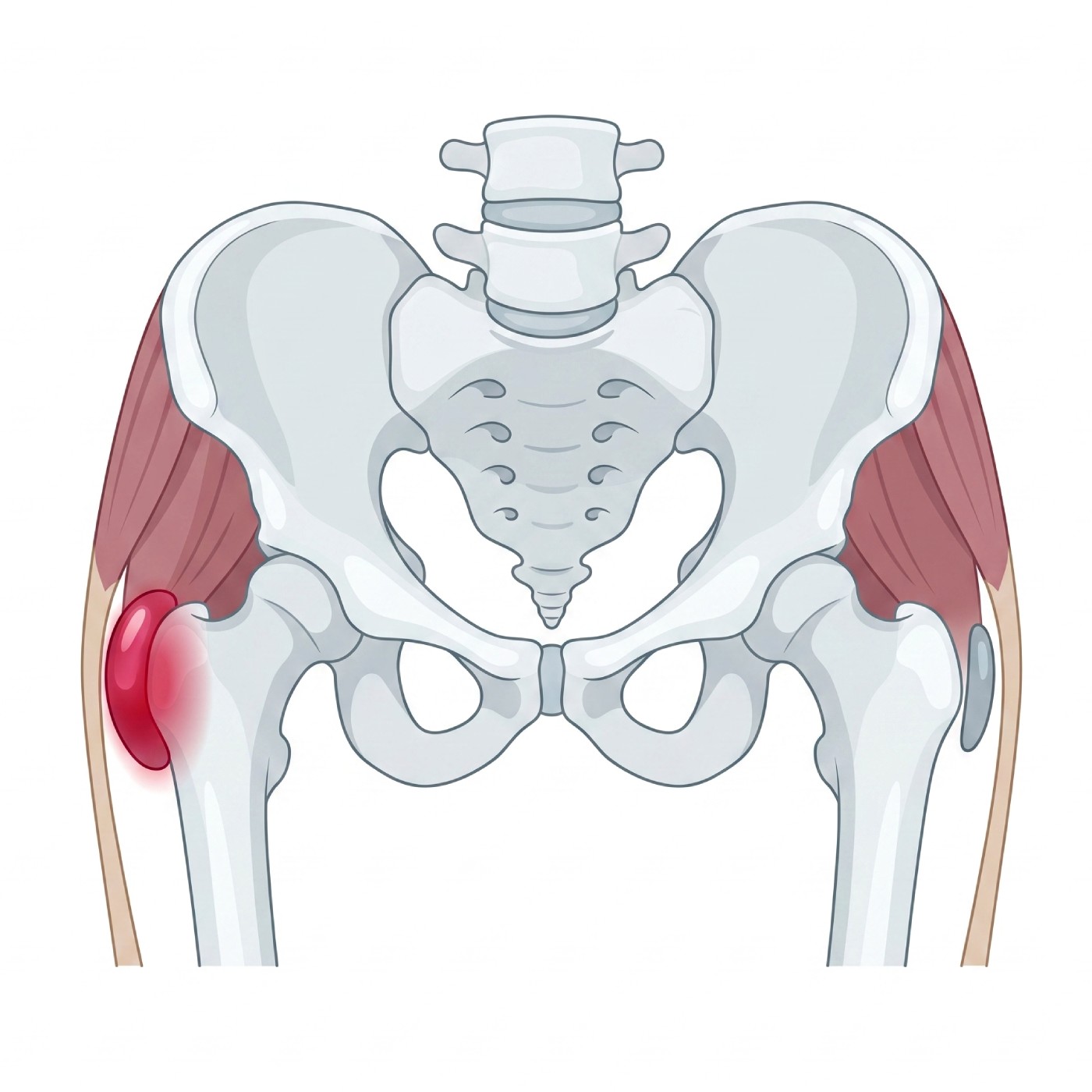
🎙 Lateral Hip Pain: Stop Blaming the Bursa (with Whitney Lowe & Til Luchau)
Til and Whitney unpack why the old “trochanteric bursitis” diagnosis is almost always wrong—and what that means for your hands-on treatment.
✨ Topics discussed include:
• The shift from bursitis to tendinopathy: only about 8% of lateral hip cases involve true bursitis; the majority are gluteus medius/minimus tendinopathies compressed under the IT band
• Why women are affected at a 4:1 ratio—declining estrogen, wider pelvis geometry, and IT band bowstringing
• Why direct deep pressure on the greater trochanter can backfire—neural sprouting, pain prediction, and the GPR83 pathway
• Smarter treatment: targeting gluteus maximus and TFL to reduce IT band compression, rather than trying to “loosen” the band itself
• Simple assessment tools: the 30-second single leg stance, the shoelace test, and the bilateral night pain pattern
• Stretching caution: why aggressive IT band stretching increases the very compression you’re trying to relieve
🌱 Sponsor Offers:
• Jane App — Practice management built for health and wellness practitioners. Thinking Practitioner listeners get a free first month; enter code THINKING1MO at checkout: https://a-t.tv/jane
• Deep Roots Massage & Bodywork — Carefully crafted, small hands-on CE workshops in Keene, NH. Save 10% with code THINKING: https://deeprootsmb.com
• ABMP — Associated Bodywork & Massage Professionals. Thinking Practitioner listeners save at https://www.abmp.com/thinking
• Books of Discovery — Explore their collection at https://www.booksofdiscovery.com and save 15% with code thinking
• Advanced-Trainings — Try one month free of Til Luchau’s A-T Subscription with code thinking: https://a-t.tv/subscriptions/
• Academy of Clinical Massage — Grab Whitney’s free Assessment Cheat Sheet: https://academyofclinicalmassage.com/cheatsheet
✨ Watch the video / connect with us:
• Til Luchau – https://advanced-trainings.com | https://facebook.com/advancedtrainings | https://instagram.com/til.luchau | https://www.youtube.com/@AdvancedTrainings/podcasts
📧 Email us: info@thethinkingpractitioner.com
The Thinking Practitioner Podcast is intended for professional practitioners of manual and movement therapies — bodywork, massage therapy, structural integration, physical therapy, osteopathy, and similar professions. It is not medical or treatment advice.


Full Transcript (click me!)
The Thinking Practitioner Podcast:
Episode 172: Lateral Hip Pain: Stop Blaming the Bursa (with Whitney Lowe & Til Luchau)
Whitney Lowe
Welcome to the Thinking Practitioner podcast,
Til Luchau
a podcast where we dig into the fascinating issues, conditions, and quandaries in the massage and manual therapy world today.
Whitney Lowe
I’m Whitney Lowe,
Til Luchau
and I’m Til Luchau
Whitney Lowe
Welcome to The Thinking Practitioner.
Til Luchau
We are so glad to welcome Deep Roots Massage and Body work in Keene, New Hampshire, as a new supporter of the Thinking Practitioner. Deep Roots is a massage practice that’s expanding into continuing education for massage and body work professionals, and like us, they are drawn to the art and science of evidence-informed practice. They’ve built a reputation for hosting carefully curated, hands-on workshops with some of the field’s leading instructors, and they keep class sizes small. That’s one of their key features, so that you can actually get individualized attention and the kind of substantive group discussion that moves your practice forward. This year’s lineup includes Advanced Myofascial Techniques; that’s the stuff I teach for whiplash and acute injuries, visceral anatomy and manipulation, Thai massage, and a Leg, Knee, and Foot masterclass with myself, Til Luchau, to see their full schedule, and to register, visit DeepRoots mb.com that’s D E E P R O T S M, like Mary, E like body.com and use the code Thinking at checkout to save 10% on any upcoming workshop,
Whitney Lowe
and the Thinking Practitioner is also proudly supported by ABMP, the Associated Body Work and Massage Professionals, the premier association for dedicated massage and body work practitioners like you, and do note that when you join ABMP, you’re not just getting industry leading liability insurance, you’re getting practical resources designed to support your career from free top-tier continuing education and quick reference apps like Pocket Pathology and Five Minute Muscles. ABMP equips you with the tools that you need to succeed and grow your practice. ABMP is committed to elevating the profession with expert voices, fresh perspectives, and invaluable insights through their CE courses, the ABMP podcast, and Massage and Body Work magazine, which features industry leaders like my co-host, Til, and myself. Thinking Practitioner listeners like you can get exclusive savings on ABMP membership at abmp.com/slash thinking, so join the best and expect more from your professional association. And I would like to say big welcome back to Til, who’s now back from some long distance travels. And great to have you back here on The Thinking Practitioner with me again.
Til Luchau
It’s been a little while. It is good to be back with you, Whitney. I’m pleased about that, and I’m pleased about our topic today. It’s always fun to pick from really technical things, or really philosophical things, or really reflective things, or really practical things. And I think this topic that you’ve nominated for us today is going to get some interest from those of us who really love the technical, specific, and practical sides of what we do. What are we talking about today?
Whitney Lowe
Well, we said we’re going to have some discussions on lateral hip pain today, of looking at some of the things. There’s been some pretty radical and significant shifts in the scientific literature in the recent years about what really causes a lot of lateral hip pain problems, and this has some very relevant ramifications for us as soft tissue manual therapists. So we’re going to take a deep dive into looking at greater trochanteric pain syndrome today.
Til Luchau
Do you want to start there? How has our understanding of lateral hip pain shifted, and how does this change our approach?
Whitney Lowe
Yeah, this is one of the most significant factors, is a move away from what’s for many years been referred to as trochanteric bursitis. You know, there’s just not a lot out there in the very lateral hip region to be sort of the culprit for a lot of lateral hip pain that people were experiencing, and so consequently I think a lot of the pain was blamed on the bursa that sits just underneath the skin, underneath the iliotibial band, over the top of the greater trochanter, there as the inflammatory culprit, as the culprit of the pain problems that people were feeling, but some, a good bit of recent biomedical research looking into tissue functions, tissue pathology, and the quality of what’s happening in these different pain conditions has really dramatically changed that picture, and we’re finding that one of the studies that I was reading was saying close to the number of people who actually have trochanteric bursitis or inflammation of that greater trochanter bursa is only about 8% of these people with the lateral hip pain problems and more commonly this is really. A problem of tendinopathy with our gluteus medius and gluteus minimus tendons, and we’ll explore here a little bit more about the the why and the what and why around that.
Til Luchau
Wow, you just laid out the problem and gave the punchline all in one. You told us like how we used to think about it, what it was, and what we’re finding, and where to focus now. Before we dig in, I’m wondering if we should describe a little bit what we mean by lateral hip pain. What would clients complain about, or how would that be recognized really clearly or simply?
Whitney Lowe
Let’s sort of dig into a little bit more, the just in reviewing the sort of structural landscape, so to speak, in that area, so the greater trochanter is, of course, that bony prominence on the lateral aspect of your hip that most everybody can feel pretty easily when you palpate the lateral hip region, and we have two pretty strong muscles that are pulling on the iliotibial band that lie directly over the greater trochanter, we have the tensor fasciae lata coming in from sort of the front side, and then the gluteus maximus coming in from the back side and fanning together into their attachment sites on the iliotibial band. Excuse me, and I believe seeing somewhere it was saying that close to 80% of the gluteus maximus fibers attach into the iliotibial band, so, and remember that’s a big powerful muscle, so there’s a lot of tensile loading transmitted through that gluteus maximus into the iliotibial band, and then the iliotibial band is lying directly over that greater trochanter, and then underneath it we have the gluteus medius and gluteus minimus muscles, which also attach out there near the greater trochanter, and part of what they’re doing is, you know, they’re going over the top of that bony projection to their attachment sites down on the femur, and this is where a lot of the problem is coming from, and we’ll explore this a little bit more. It has more to do with tendon compression by the iliotibial band, because the iliotibial band is such a rigid, dense structure that lies over the top of them, and when it gets pulled tightly from both positional things or chronic overuse or various different biomechanical factors, it pulls tight and presses those tendons against the bone underneath, and so we’re seeing the tendon dysfunction, not from the pulling stress of muscle contraction constantly pulling on a tendon, like we usually see in many tendinosis complaints. This is a tendon disorder that results from compression of these tendons against the underlying bone,
Til Luchau
and this will be reported by a client, like, “Oh, just my hip hurts, or “It hurts when I lie on my side, or it hurts when I shift my weight over to one foot, or hurts when I cross my legs. Is that right, that I forget anything?
Whitney Lowe
Exactly, those are the main things that we’ll hear people say. Is that that pain in the in bed at night, lying on the hip, but also we’re going to talk about this in a moment too. Also, lying on the unaffected side also causes pain, but the what you mentioned, too, is a real common of like standing on one leg. It’s when they stand on the affected side that tends to hurt a lot more, and there may be, you know, a lot of times up and going up and down stairs or other things that are using significant degrees of hip flexion
and extension or other vigorous activities. Maybe if they’re running or doing other kind of vigorous activities, they’ll feel that lateral hip pain associated with those activities as well.
Til Luchau
Okay, so that’s the where this the outside of the hip. You’ve given us a hint as to the explanation for why it’s this idea of tendon compression over the greater trochanter. Why are what are the statistics tell us about the prevalence, and why are women affected so much more.
Whitney Lowe
This is pretty interesting. So we see almost a four to one ratio of women to men affected by this particular condition. And again, I mentioned this at the very beginning, we’ve moved away from the term trochanteric bursitis, since the bursa does not seem to be the primary cause in many of these conditions, and now the more common term is greater trochanteric pain syndrome, and so women are affected, for there’s two main reasons that we see a much higher percentage among women, again this is generally women in sort of the middle age range, things about this, when I was reading the other day, I used to think of people in middle ages, you know, somebody who was older than me, and now middle-aged people are youngsters, but yeah, the declining estrogen levels in middle age are generally associated with chronic tendinopathies, not only here but in a number of different places, and this has to do with some various biomechanical factors about where the hormone, you know, the hormones are affecting some of the tenocytes or the cells in the tendon, so decreasing estrogen levels definitely play a role in a number of chronic tendon pathologies, so that’s sort of it, is yeah, the. Sort of the biochemical factor, and then there is another prominent biomechanical factor, which is the wider pelvis, means the iliotibial band, and usually there’s with the wider pelvis, there is a greater degree of valgus angulation of the femur, which means the distal end of the femur, toward the knee, is aiming inward toward the midline of the body that pulls the iliotibial band tighter against that greater trochanter, so the wider pelvis sort of bow strings that ITB across the outer aspect of the hip, meaning there’s going to be more compression underneath underneath as well.
Til Luchau
You’re referring to the tendency of birth females to have a wider hip structure, wider pelvis existing that just changes the angle of pull that there’s more bow stringing over that trochanter.
Whitney Lowe
Yeah,
Til Luchau
hips are wider as well.
Whitney Lowe
Yeah,
Til Luchau
interesting. So, how, given that cortisone injections are often prescribed for the bursitis that we used to think it was, how common is that bursitis without gluteal tendon tendon pathology was that the 8% figure you quoted,
Whitney Lowe
So, again, and this is an interesting thing, if corticosteroinjections are given for that condition, and only roughly 8% of the people really have an inflamed bursa, you’re running that risk of further degenerating the impacted connective tissues, because we do know that corticosteroid injections have a deleterious negative impact on collagen construction in connective tissues, and that can cause long-term degenerative impacts on them as well, so it’s just not only is it not a good thing, and may, in many instances, really be a bad thing to be doing that for this?
Til Luchau
Well, even when it can resolve pain, it’s basically doing that by turning off the physiological functions of the tissue, including the inflammatory ones that are part and parcel with tissue formation, cortisone deposition, sorry, collagen deposition, things like that. So, yeah, that’s interesting. That to switch from thinking of it as a bursal inflammation to a tendinopathy, which suggests different mechanisms, changes are the role for injections, but also changes maybe what we do with our hands.
Whitney Lowe
Yeah,
Til Luchau
So tell us a little more about the how the ilitibial band is like a compressive roof over the tendons. What’s stress shielding of that?
Whitney Lowe
Yeah, so going back to physiology for a second, and a lot of people, and we’ll sort of get into this as we talk a little bit more about treatment a little bit later on, there’s there’s a lot of focus on people saying, “Oh, man, my IT band is so tight, we got to figure out how to loosen this thing up. But it’s really important to remember that the iliotibial band is a tendon, it’s a basically a sheet tendon designed to transmit very high tensile loads down into the lower extremity in order to maintain stability of of the lower leg, and you know, I ran across this when I was doing some research on this, this was just a couple weeks ago, and I have not had the opportunity to verify this, but this was something new that I had, did not know, that apparently our cousins in the primate community, chimpanzees and gorillas do not have an iliotibial band. Do you know if that’s true?
Til Luchau
You’re ringing a bell for me that I’ve heard this before. I don’t know definitively, and certainly there’s.. we get.. we’re going to talk a little bit about the Trendelenburg sign. There’s more of a Trendelenburg walk amongst primates than humans do, and that’s what happens in humans when you can’t engage the iliotibial tract function,
Whitney Lowe
Yeah, and that would make sense because we are, you know, in order to have the smooth bipedal locomotion that we have as humans, you need to really stabilize that lower extremity and put a lot of stiffening in the lower extremity, especially during the very end of the lockout phase, right before heel strike, and that iliotibial bandits is really necessary for it to maintain a greater degree of tension. So, in doing that, it’s a real stiff, unyielding structure that you know presses down from above on those tendons, and they just, they can’t really, you know, it’s like a very hard metal sheet, just, you know, constantly pressing down on them and squeezing them
Til Luchau
above, meaning superficial, to
Whitney Lowe
superficial, to yes, clarification here, superficial to them,
Til Luchau
so that’s that hip sway, or hip, the hip drop of the Trendelenburg sign could squeeze the typical electrical band tighter down as that compressive roof onto the tendons underneath it.
Whitney Lowe
Yeah, absolutely.
Til Luchau
And so, what’s stress shielding?
Whitney Lowe
Yeah, so you know, stress shielding basically is is the term that’s used to talk about the, you know, the the compressive loading on. Those tendons by the iliotibial band, just being a very dense, unyielding structure over the top of it, not allowing them to move, not allowing them to expand, or not allowing them to kind of get out of the way. So it’s kind of like a very rigid border that they just can’t escape, that constantly puts a load on them there. So, and then there’s a second, yeah. To you mentioned the Trendelenburg sign. I think we should explain that a little bit. Do you want to explain or what that’s about, or do you want me to chime in on that?
Til Luchau
Chime in anytime, but the Trendelenburg sign, or Trendelburg gate, is a dropping of the contralateral hip, when you step with your right foot, your left hip would drop in an exaggerated Trendelenburg sign, and some of that, depending on the model, the biomechanical model you’re working from, some of that might be desirable, but it depends on the magnitude of how much the pelvis drops with weight shift,
Whitney Lowe
yeah,
Til Luchau
and, and the maybe one of the ideals, and say athletic performance, as such, is a level pelvic structure. A structure is able to maintain a degree of levelness through all phases of the gate,
Whitney Lowe
yep,
Til Luchau
which Trendelenburg is a lack thought to be a lack of control around the weight-bearing hip and allowing it to drop on the contralateral side. How did I do, Whitney?
Whitney Lowe
Excellent, and it is an absolutely essential part of human locomotion, because if you think about it, as you were mentioning, though, let’s say, for example, your right leg is the weight-bearing leg in this portion of the stride, in order for you to swing through the swing the left leg through during the swing through phase, it’s got to clear the ground, and for it to clear the ground, you have to hike the hip up on the left side, so that that leg swinging through doesn’t just drag on the ground, and that’s mainly done by the hip abductors on the weight-bearing side, in this instance, the right side contracting and sort of causing the hip to move into a functional abduction, which is basically laterally tilting the pelvis to the right, so that that left leg swinging through, and then, as you noted, if the hip abductors, the gluteus medius and minimus, are weakened, then that pelvis will drop down on the left hand side when you’re weight bearing on the right side, and and the Trendelenburg gait that we refer to is, I mean, it’s hard to kind of talk through what that looks like, but you know, people will sometimes swing that leg around because it can’t clear the ground swinging straight through, so you’ll see them kind of like swinging it around to the side, and that’s a common indicator of some significant neurological disorders when there is a impairment of that function of the gluteus medius and minimus as well.
Til Luchau
Okay, are we ready to talk about neural sprouting? What
Whitney Lowe
is that fascinating?
Til Luchau
Yeah, how does that create the tissues hypersensitivity, all that kind of stuff?
Whitney Lowe
Yeah, so this is again improving or changing our understanding of what happens in tendon pathologies, so I know back in the days when you and I first went to school and first started learning about these things, we were told that tendinitis was a chronic, you know, inflammatory condition caused by tendon fibers tearing and the resultant scar tissue and inflammatory process going on in there, but we now understand chronic tendinopathies most commonly are associated with loads on the tendon that are inappropriate, causing some degree of degeneration in the tendon, and what we start with as healthy functional type one collagen in the tendon gets sort of expanded in the early stages of tendinopathy, when there’s excess stress on the tendon, and you get an increase of water content in the tendon, as
the tendon tries to expand a little bit, and to manage that increased load, and then eventually there’s a degree of degenerative processes that happen in the tendon, and during those degenerative processes, there’s a an influx of type three collagen, which is very poorly organized collagen matrix being lie laid down in that tendon, and along with that comes excess vascularity, which is increased very tiny blood vessels that are coming in trying to help repair the potential load damage in that tendon, and along with that comes increased neural branches as well, so very, very fine branches of nerve endings forming in along with this increased vascularization, and this is the primary pain causer in tendon pathologies is this increased vascularization and increased neural pathways that are being sort of grown and enmeshed into the into the repairing tendon fibers,
Til Luchau
maybe I’ll offer a reframe to say that’s one of the theories of primary pain, because there is debate about whether it’s. Is signal related, like more nerves giving more signal, or more sensitivity, meaning less descending modulation, those kinds of things. But that’s a very predominant and accepted def explanation for the pain that comes into, yeah,
Whitney Lowe
and I certainly wouldn’t be surprised to say, like, probably is all of those things, yeah, right together, because it’s not so much just one exclusive factor. I think you’re right that there’s likely a number of things that are contributing to that.
Til Luchau
I should like footnote the conversation you had with Jill Cook, too, who’s kind of the godmother of this new understanding of what happens in tendon problems. So, it was that was an interesting episode, and the neural sprouting and the vascularization, the word that’s sometimes used is arborization, like this sense of becoming more branched, little branches that proliferate into the healing tissue in an attempt to heal it, but in what is thought to happen is it increases the level of insensitivity or amount of signal that’s coming from those tissues,
Whitney Lowe
arborization. I love that. That’s great.
Til Luchau
Okay, so we talked about the Trendelenburg gait. We didn’t mention a crossover running style, but that deserved to be sitting, or sitting cross-legged. Those things all increase compression, but why do clients with this lateral hip pain experience severe night pain when they’re sleeping on either side, so that typically pain is more severe at night, and then but why is it either side?
Whitney Lowe
Yeah, so it’s pretty easy to see why they’re going to get pain on the affected side, because their body weight is lying down and pressing on that irritated tissue on there, so that makes that makes clear sense. So there’s greater compressive loads on there, and
Til Luchau
I just bought a new mattress. Sorry, I just bought a new mattress, and they were highlighting this about how comfortable they were for the hips, and there’s that’s such a big deal, is getting a bed that doesn’t make your hip hurt when you lie on it, especially after a certain age, this lateral hip pain is also age related.
Whitney Lowe
Yes, yeah. And
Til Luchau
so the algorithm spotted me as someone in my beyond middle age, let’s say, and we’re letting me know that there’s their mattress is going to be really comfortable on my hips,
Whitney Lowe
nice. Yeah, right. So, and again I just want to sort of reiterate when we’re talking about these tendon pathologies that remember that tendons are so well designed for high tensile loads because that’s what you know they are designed to do but they are really quite poor at responding to compressive loads and so this is one yeah
Til Luchau
bunch of cables like on the Golden Gate Bridge or something, those big giant composite cables you see with fibers and wires, it’s all collagen cells all spiraled in together in one direction. So you’re saying, like, when we get a compression force or a force from a different direction, they don’t respond very well to that.
Whitney Lowe
And that’s a great example, because when you think about it, like the tensile loading along the parallel direction of those fibers, the it’s sort of like you get the maximum strength by everybody getting pulled in the same direction, but when the force comes compressing those tenons, it’s coming at a 90 degree angle to those fiber directions, and so they’re definitely not designed to handle that too well.
Til Luchau
I was so distracted by my remembering my mattress shopping, so we talked about how lying on that hip could make it hurt. Did you talk about why the other hip could hurt too?
Whitney Lowe
Let’s get back to that. What I was going to say is what happens when a lot of people are sleeping at night on the non-painful side. Let’s say your right side hurts. It’s easy to see why it hurts when you lie on your right side, but when you flip over onto your left side and then you drape your leg sort of across the front of your other leg, you’re pulling that hip into adduction, which is just like the sort of crossover running style you mentioned a moment ago, so and then you keep it in that position for long periods, you’re once again pulling that it band tight across the top of those tendons and increasing that stress shielding on those tendons and putting the compressive loads higher on those tendons, so there’s an easy answer to this, and an easy solution to that is if you can put a pillow in between your legs and that
keeps the upper leg in more neutral position and keeps it from from pulling so much on the on the it band,
Til Luchau
there’s another factor that I’ve been working in myself. I do get some lateral hip pain, not too bad. I get more shoulder pain at night, and it’s.. it seems to be related in my case to just overall sensitivity of my system. Yeah, and there’s more inflammatory reactivity, there’s more neural sensitivity, you know, more emotionality, all that kind of stuff at night, and so all those things combine to mean that if it’s a little sore in the day, it’s probably going to be really sore at night, especially as we quiet down.
Whitney Lowe
Yeah, and
Til Luchau
just be still. We stop the motor traffic, motor down traffic, and we just just get the sensory side. So that’s another reason that things get sore at night, even on the upper side, without the mechanic, with or without the mechanical factors.
Whitney Lowe
Yeah, and that’s an excellent point, because what you’re also noting here is it’s not really exclusively mechanically driven, because it should be. It should feel better when you take a load off at night, and you’re not standing, you’re not doing all those kinds of things. One would think, like, hey, this should feel better, but if, if it’s something like that is still getting aggravated in those non-loaded positions, that’s when you have to start thinking a whole lot more significantly about those various other factors that you mentioned, all the nociplastic pain factors, the biopsychosocial factors, and all those other things that are playing into that messy soup.
Til Luchau
So, there’s a.. there’s.. I mean, we’re getting into.. if I want to make this really applicable to hands-on therapists, manual therapists, massage therapists, etc. This makes me think of questions we could be asking, like, have does it all, you know, does it hurt when you sleep in a different bed? Does it hurt when you have you tried a pillow between your legs?
Whitney Lowe
Yeah,
Til Luchau
how’s your stress load overall? What are your nights like? All those questions that just are reflective questions, more than, say, diagnostic, because staying in my scope of practice and staying in my lane of a hands-on therapist, but to get people reflecting on and perhaps
Whitney Lowe
including those factors in their own work with their symptoms can be really helpful. Yeah, and that’s just a reflection back into to what I kind of went over in the our previous episode on the Op QRST model,
about why it’s so important to pull out those kind of details from a comprehensive and detailed history, when you’re talking to your clients at the outset, it’s not just figuring out some things about what you’re going to do, but you learn so much, and you can help them so much by giving some suggestions, like you mentioned, of things that they can be doing at home that will help
Til Luchau
so much super helpful episode, lots of practical ideas, that was number 170 so what are the most reliable provocation tests, physical productation tests for the before we’re talking about,
Whitney Lowe
yeah, you know, this gets into an interesting thing, because so many of the orthopedic tests that were the mainstay of evaluation for decades in that community have really kind of sort of begun to take a back seat, because we’ve looked at their specificity and sensitivity and found that many of them just aren’t really that accurate in finding some of these things, but there’s some simple procedures, and one of them is the 30-second single leg stance procedure, which is basically you just ask somebody to stand on the affected hip on that particular side, like if it’s the right side that’s that’s painful, you ask them to stand on that right foot only for about 30 seconds and see if this tends to increase the pain sensations on there, and that would be an indicator
Til Luchau
of standing hip, yeah,
Whitney Lowe
on the standing hip, because you are again really pulling on that gluteus medius minimus, and I mean, excuse me, the TFL and the gluteus maximus, pulling on that it band to maintain the stability in that single leg stance, and that would be something that would oftentimes off sort of set off the pain sensations after, after that roughly 30 seconds or so.
Til Luchau
That’s also a test that’s commonly used to assess balance and equilibrium.
Whitney Lowe
Yeah,
Til Luchau
so, and it’s remarkable how challenging it can be to balance on one leg for 30 seconds.
Whitney Lowe
Yeah, yeah,
Til Luchau
and and if these sensitivities or pain flares up during that time period, that gives us some really clear things to work with as hands-on therapists.
Whitney Lowe
Yeah, and this also helps, you know, in kind of the cross-referencing process of trying to make determinations of, like, you know, is this in fact what we think it is with with the tendon problem, or you know, might this be like, you know, hip osteoarthritis, or something like that, because they could give some very similar kinds of things, and there’s another simple procedure called something like the shoelace evaluation, or shoelace test, or something like that, which is a person with this greater trochanteric pain syndrome generally does not lose significant range of motion in their hip, and can still bend down and shy their shoes, and do that really easily. Where a person with osteoarthritis in the hip is going to have a lot more challenge and trouble because of the rotational factors in their hip joint capsule when they try to tie their shoes, and so that’s a clarification that can can help us make a deterrent determination about those
Til Luchau
fascinating, so if, if some, if a client has a sensitized system, why would you, the wording we have in our question is aggressive deep tissue work be contraindicated? What will we do instead?
Whitney Lowe
So you know, a lot of times we have this sense, like, when there’s a, you know, a tendon or a muscle problem, as massage or manual therapy practitioners, just like, well, let’s get in and, like, get that trigger point, or really dig in there with our elbow, and we’ll work that thing out, and I have talked to so many practitioners, and also clients who’ve gone to see practitioners who just said somebody just really pushed them over the edge with the level of pressure that they were using and flared this up and made it worse, and this is really important to remember, is we’re kind of like understanding and recognizing the way in which the system responds to different type of work that we’re doing, and so there’s not a lot that we are going to do that’s going to directly sort of take that load off, short of trying to reduce hypertensity or tightness in muscles like the gluteus maximus and the tensor fascia lata, but that’s
Til Luchau
big. I want to take out my highlighter and highlight what you just said. Those are really key that you’re saying we’re not going to press on the part that hurts,
Whitney Lowe
right?
Til Luchau
We’re going to think about what is what the bow string is doing, and we’re going to work the bow instead of the spot where it’s pressing on
Whitney Lowe
Because think about it, just, you know, pressing on the compressed tendon, which is irritating because it’s getting compressed, that’s not really going to be particularly helpful, and may even be really detrimental, so
Til Luchau
getting pressed a lot by the factors involved. No one is going to.. this is why I like this question. No one is going to describe their own work as aggressive deep tissue, right? That’s how we describe other people who we don’t want to be whatever, but it’s worth saying again, even though it feels good to the client to work there on the sore spot.
Whitney Lowe
Yeah,
Til Luchau
gonna go, oh, that’s the spot. Oh my god, no one has found that spot yet. Often, if it is this kind of situation, they’re going to feel worse later, and it’s going to keep them in a state of irritation that’s going to be harder to recover from.
Whitney Lowe
And what you’re bringing up there is a critical, crucial point. And I want to just dive for just a second into some other neurophysiology as we look at, you know, how those sensations are getting reported to the central nervous system, because there is a – there’s a neural pathway called the GPR 83 pathway, and there are the GPR 83 neurons are sensitive to both a degree of discriminative touch, like where are you touching and what way that you’re touching, but also more about the affective nature of that touch, meaning what is the emotional response to that kind of touch, and if you think about the way you might work with somebody’s hip in this region, you could give a moderate degree of pressure of the stuff that you’re doing, or a nice comfortable degree of, let’s say, you know, fascial type work on those superficial aspects of gluteus maximus and TFL, and give a really good, pleasing sensation to the person that makes their whole nervous system turn down the volume, but then you come in and you start working deeper and more intensively, and all of a sudden that switch turns over from an enjoyable sensation to one that the person braces against, and that the nervous system kind of wants to like stop and fight against, and that really can sort of push us into those sort of more noci plastic pain sensations, or pain states that you were talking about earlier, and like this is why it’s so important to try to keep under that umbrella of the comfortable, soothing application of our work, as opposed to the intense get in there and dig it out kind of mindset that you know was sort of prevalent for a long time,
Til Luchau
and sometimes helps some things, but in this case unlikely to this was,
Whitney Lowe
yeah, yeah,
Til Luchau
okay, so how does targeting the TFL and Gluteus Maximus lower the compressive load, and are we? Is that because we’re softening the iliotibilal band?
Whitney Lowe
Well, it’s certainly been a, it’s certainly been a theory or an idea that has been promulgated quite extensively, and it sold a lot of foam rollers for people.
Til Luchau
So, do you think we’re softening the iliotibial band?
Whitney Lowe
I don’t
Til Luchau
Trick question.
Whitney Lowe
I’m not in that camp. I’m not a believer of softening the iliotibial band, mainly because, you know, again, it’s a tendon. Now you gotta, you gotta say, like, but wait, I feel like things soften under my hands when I work in this area, and I think we have to kind of remember physiologically what may be happening, a number of different things that might be going on there. The softening sensation that you feel could be a couple things, it could be, you know, a reduction in sort of hypertonicity in the vastus lateralis muscle, because remember that muscle also goes all the way underneath the iliotibial band around to the back side of the thigh to some degree, but also depending on the things that we’re doing, if we are applying pressure over that iliotibial band that’s not into that zone that is, that is really uncomfortable, but let’s say we’re applying, you know, shearing forces to the subcutaneous fascial layers, there, we are going to stimulate that process of hyaluronan production and make those tissues move more mobility with each other and improve that slide and glide sensation. It’s going to feel like it is softer, but you haven’t really loosened the IT band. Basically, what you’re doing, you’re helping to mobilize surrounding tissues and improve their, their mobility around each other, and that’s definitely beneficial and helpful, but it’s not something that, at least personally, I don’t think we’re doing anything to to loosen or soften the iliotibial band,
Til Luchau
and yet working on it often helps things like this, so what’s the without softening it? Maybe we’re changing its tone or the tone of the muscles, the skeletal muscles that attach
Whitney Lowe
to it. Yeah,
Til Luchau
and that’s what seems to help sometimes that lateral hip pain when we help the bow string structures be less taut or have a greater range of tones
Whitney Lowe
exactly, and so there’s like, if you think about it, is like you’ve got a wire that’s running across or a rope that sort of is running across a rock or something like that, and you pull that rope really hard, the more you pull on that rope, the greater is the compressive load of that rope across the upper portion of the rock there, and so if you loosen the rope and slacken it a little bit, you’re not going to compress that rock as much right underneath where that force is, so the
Til Luchau
wait a minute, loosening, loosening, slacking, let’s, let’s stick to our metaphor. We’re not softening, loosening, or slacking the rope. Perhaps we are helping the rope be more adaptable. No, you’re right. If we’re reducing the pull on it, the skeletal muscle pull, right? Yeah, and the rope is a little more, little less taught. It’s not from stretching the rope itself, not from making the rope more elastic,
Whitney Lowe
exactly. So, I like to think of, like, the rope is the iliotibial band, and my hands that are pulling on it are the IT band, and, excuse me, the tensor fasciae lata and the gluteus maximus, and if I loosen my grip or let go a little bit, then that whole rope tension decreases, and that’s going to decrease the compressive loads on those tissues that are affected,
Til Luchau
we see that on the medial too. In what I’m blanking on it, medial knee pain, pes and serena syndrome. Yeah, where a lot of times direct work on it can flare it up, but working with this constituent structures, chrysalis, you know, the gluteus, sorry, the adductor magnus or longer, the different things that come together across the medial knee can really change the way that that pain is triggered, can change the sliding there, and I probably named the wrong muscles, but that’s that’s the structures there. Yeah, so
Whitney Lowe
Gracilis, if I’m remembering correctly, Gracilis semi tendinosis and
Til Luchau
semi tendonosis,
Whitney Lowe
yeah,
Til Luchau
and
Whitney Lowe
the sartorius,
Til Luchau
sartorius. Thank you.
Whitney Lowe
S T G, yeah, STG, yeah,
Til Luchau
similar principle on the on the inside of the knee, and I’ve, I’ve seen some dramatic results from that, not necessarily working on the spot that hurts, but working things above and below that range in movement with this idea of helping them have a greater adaptive range.
Whitney Lowe
Yeah, and that’s that’s unimportant within. As you bring up, there is like a lot of times the more we can kind of get a good sense of understanding those those chain patterns, those kinetic chain patterns, and recognize that a lot of what we’re doing, of just soothing those areas and trying to get the sort of mechanics normalized, the nervous system normalized, the overall effective quality of our touch, making a pleasant sensation to reinforce those things with the nervous system, all those things play into the beneficial results that we get,
Til Luchau
and how about stretching? A lot of us, you know, want to stretch something, whatever. How about stretching the side of the hip or the otibial band for this situation? What?
Whitney Lowe
Yeah,
Til Luchau
what can help? What can worse than that?
Whitney Lowe
Yeah, that’s.. I mean, so often it’s like, well, it hurts out there, like I just need to go out and stretch those muscles. So we’ll do these, you know, deep iliotibial band stretches, like leaning against the wall and leaning into the wall with your foot sort of pulled out away from the wall, but what you’re doing is you’re just pulling more attention on that affected structure in there, and I, you know, generally in terms of like what the, a lot of the literature was saying, is like that’s probably not the best strategy at this stage, like there’s a place for. Stretching certainly in increasing some degrees of mobility and range of motion, but right now what we’re trying to do is to is to decrease the tensile loading on that whole complex there, and so stretching, especially any kind of aggressive stretching in that area, is going to be magnifying the problem and not so much really relieving it until we can really reduce the the hyper tendency and tightness in those those other key muscles, TFL and glute max.
Til Luchau
Any thoughts on loading? Because tendons like the loading along their lines, and this is like getting out of our lane a little bit, but what do you have thoughts about that?
Whitney Lowe
Well, yeah, if you want to, if you want to talk about the ideal protocol for tendon rehabilitation, is you know this is where you kind of, kind of see something like the role of manual therapist and physical therapists with strengthening exercises be so well designed to work together, because if we reduce the hypertonicity in the muscles that are pulling on the iliotibial band, and then gradually move that person into this strengthening exercises for their hip abductors, because that’s what really helps tendons heal best, is loading in the directions that the tendon is designed to pull and mainly this, the two, there’s a bit more emphasis, a lot of times, on eccentric loading of them, so you know, pulling the leg down into abduction from a point where they were pushing out away, but there’s also an eccentric contraction as the muscle is gradually elongating, those tend to be more beneficial in the sort of reconditioning process for that tendon after the after it’s moved past the sort of the damage phase
Til Luchau
that’s important for us as manual therapists, because we don’t tend to think about loading as part of what we offer, and yet for tendon rehabilitation that can be a really important factor, and there’s really interesting debates about the eccentric loading or concentric thing, but basically load seems to be a very important ingredient component in getting over something like this.
Whitney Lowe
Yeah, agreed.
Til Luchau
Any, as we wrap it up, common well-intentioned mistakes that manual therapists make. If we could summarize some of those with lateral hip pain,
Whitney Lowe
I would say that the big things to be focusing on, of mistakes to avoid, are some of the things that we talked about, of like feeling like we got to get in and dig this out of what’s going on there, but again, this is also kind of important, and this is why I lean into the whole world of assessment so much, is that there’s a lot of things that can have very similar kinds of symptoms that would benefit from, you know, more directed, let’s say, static compression type techniques, like, you know, the common myofascial trigger points in gluteus medius that also mimic both lateral hip pain and sciatic type pain down the posterior lower extremity, they do benefit from small localized, you know, pressure with elbows and knuckles and thumbs, and you know, direct trigger point work, but that’s why it’s really important to try to get a sense of what’s what’s really going on here, so we can make a determination about what’s going to be our most effective strategies in dealing with
Til Luchau
it, and if those get flared up by your work, let’s say you do some really specific direct work on something, and it gets worse. It can take a while for that to calm back down before you recover from that, and get us, can start from zero again with new experiments. Can take weeks off,
Whitney Lowe
it can. And unfortunately, what you also have to remember, if this same person is coming to see you again, there is a neural processing that you have established already, which is their brain says that hurts when that person did that thing to me, that’s when it really hurts. So, there’s going to be a lot of trepidation about having that kind of thing done again, and you’re going to create one of those prediction patterns in the brain that’s sort of bracing for the pain, kind of bracing
Til Luchau
for the pain or an unhelpful one, where boy, when they were working on it, it felt it hurt good right there, because they were pressing on the thing that hurts, and then the rest of the week I felt horrible, but let me go back to that thing that hurt good again. Yeah, that’s easy to try to keep poking that thing, because it feels interesting while you’re doing it. Yeah, and it’s harder to get the perspective to say actually they’re still suffering the rest of the time we got to back off and let them recover,
Whitney Lowe
that’s right,
Til Luchau
look at different approaches.
Whitney Lowe
Yeah,
Til Luchau
okay. So, what’s the simplest clinical reframe to wrap things up with? What should we stop thinking? What should we start looking for, etc.
Whitney Lowe
It’s just a general reframe, I would say, like, when you’ve got this lateral hip pain, don’t be terribly afraid to work the area, because a lot of people say, “Oh, it’s bursitis, so I got to stay off of there, and they, you know, don’t do anything, but the big, I think, takeaway from this is this is a great reason for lots of good work on the TFL and glute max, that it’s going to be, you know, in almost every case pretty darn safe to do, and beneficial for lots of different reasons, but just again, we’ve kind of focused on sort of breaking down and tearing apart the biomechanics of this whole area, but, like, remember, too, we’re working with people and not just biomechanical sticks and everything, so there’s a lot of the whole continuity of what we do with our whole practice and the way we incorporate, incorporate a treatment that’s going to be really helpful if you’re working on their feet, their lower legs, their upper legs, their low back area all the way up to the upper extremity in the neck region, there’s a lot of those connected pathways that we all know about that are super beneficial for working on these things as well.
Til Luchau
That’s great.
Whitney Lowe
Yeah,
Til Luchau
thank you, Whitney, for for bringing this topic up. It has a lot of things that apply out to other common common complaints we see coming in our door, and you’ve helped us think about it and apply it in terms of hip, but you know, again, it can apply to a lot of tendinopathies. Yeah, so we’ll have,
Whitney Lowe
Get out there, explore that a little bit, and you know, take some attention around some of these lateral hip pain things, and just remember, too, a lot of what we do is helping educate our clients about these things that can help keep it from getting into those states for them as well, and I think that’s certainly something we can take away with us as well.
Til Luchau
Great, this is our closing sponsor.
Whitney Lowe
Well, Books of Discovery, who’s been with us forever, and we really appreciate the support from Books of Discovery. So they’ve been a part of the massage therapy and body work community for over 25 years, nearly 3000 schools around the globe teach with their textbooks, e-textbooks, and digital resources. Books of Discovery likes to say that “learning adventures start here”, and they find that same spirit here on this Thinking Practitioner podcast, and are proud to support our work, knowing that we share the mission to bring the massage and bodywork community thought-provoking and enlivening content that advances our profession.
Til Luchau
And if you’re an instructor, a teacher’s assistant, or an administrator in an education program, you can request complimentary copies of Books of Discovery’s textbooks to review for use in your programs. Listeners can explore their collection of learning resources for anatomy, pathology, kinesiology, physiology, ethics, and business mastery at Book of discovery.com where you, as a thinking practitioner listener, can save 15% by entering “thinking” at checkout.
Whitney Lowe
And once again, we would like to say a thank you to all our listeners, and of course, to our sponsors. We appreciate the help in letting us keeps us going along the show. Here, you can stop by our sites for the video show notes, transcripts, and any extras. You can find that over on my site at academyofclinicalmassage.com And Til, where can they find that for you?
Til Luchau
Advanced-trainings.com And we want to hear from you all, your ideas, your input, your feedback, your complaints, your celebration, whatever you want to tell us about, email us at info at The Thinking Practitioner.com or look for us on social media and YouTube. I am at Til Luchau. Whitney. Where can people find you?
Whitney Lowe
They can find me also under my name, Whitney Lowe, on any of the social channels there as well. And lastly, we would just like to say we do really appreciate it if you would take just a quick moment to rate us on Spotify or Apple Podcast, or wherever you happen to be listening to your podcast. It really does actually help other people find the show, and so if you wouldn’t mind, please take a few moments to do that. And once again, thanks so much for hanging out with us, for sharing the word, and telling a friend. And we’ll see you in our next episode.
Til Luchau
See you later with me. Thanks.
Whitney Lowe
All right. See you then.
Bye.
Huge thanks to our sponsors:



Live Workshop Schedule
Stay Up to Date
…with the Latest Episode, News & Updates
Get our free Techniques e-Letter
You’ll occasionally receive the latest schedule updates, tips, secrets, offers, resources, and more. Check out our ironclad privacy and SMS policies. You can unsubscribe/stop at any time.
This Month’s Free Online Course
Our gift to you. Includes CE, Certificate, and Extras.
Follow Us
Join us on FaceBook, Instagram, Twitter and YouTube for information, resources, videos, and upcoming courses!
0 Comments