
The Thinking Practitioner Podcast
w/ Til Luchau & Whitney Lowe
Episode 179: Nerve Pain: Stop Blaming Compression (with Whitney Lowe & Til Luchau)
Transcript | Subscribe | Comments | ⭑⭑⭑⭑⭑
Or, listen and subscribe on Apple Podcasts, Spotify, wherever you get your podcasts!
🎁 Scroll down for the full video and transcript!
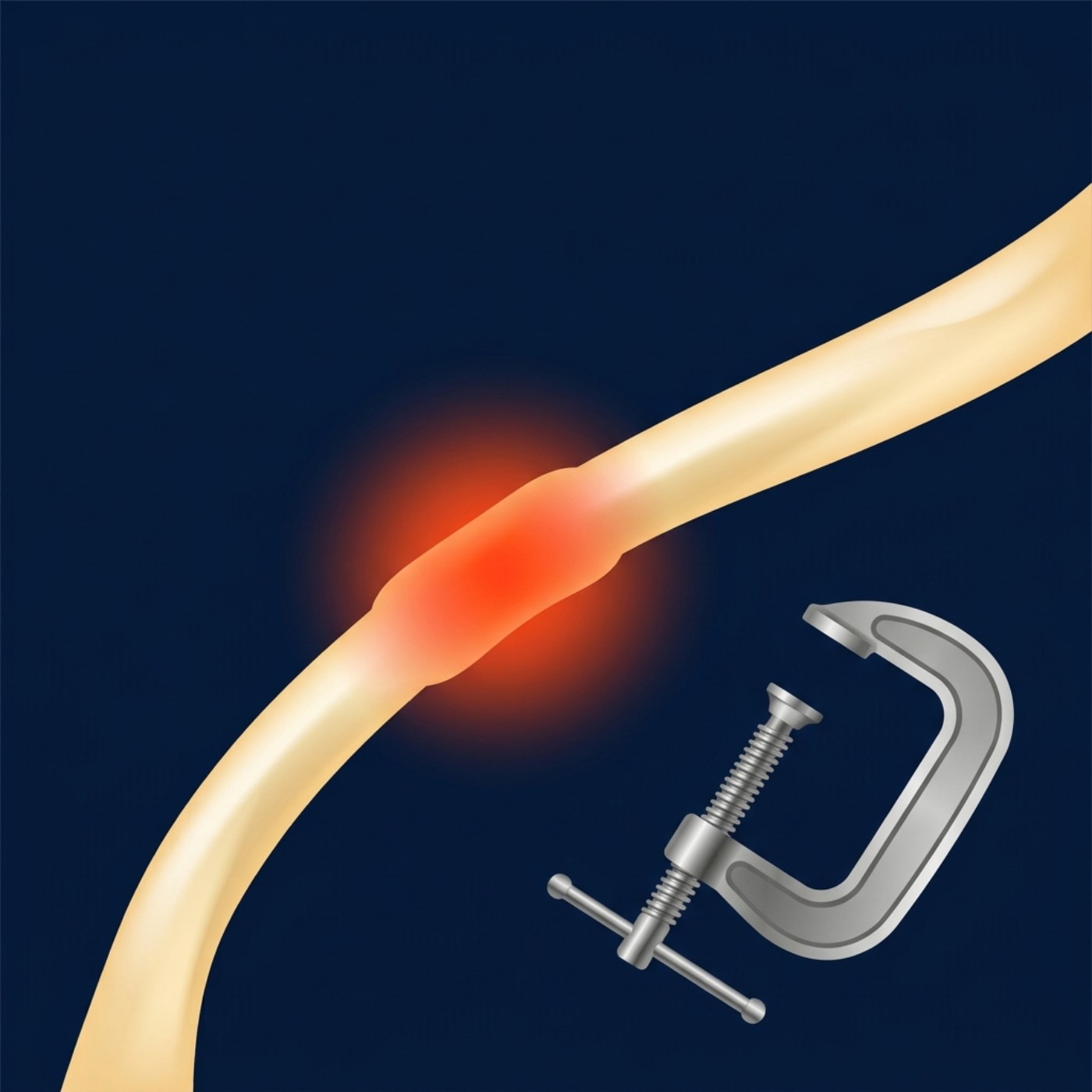
🎙 Nerve Pain: Stop Blaming Compression (with Whitney Lowe & Til Luchau)
Ask almost any manual therapist what they learned about nerves in school, and you get some version of the same answer: not much.
Most of us were handed the wiring model. A nerve is a cable, it carries a signal, and there are two ways it goes wrong — something presses on it, or something pulls on it. It’s a tidy picture, it’s most of what our field has run on for decades, and it leaves out nearly everything that makes a nerve a nerve.
Whitney and Til go under the sheath. A peripheral nerve turns out to be a living organ with its own blood supply, its own nerve supply, a fascial architecture that mirrors muscle, and a slow river of axoplasm moving proteins the length of an axon that may run three feet from your sacrum to your big toe. Once you see it that way, the clinical picture changes: the first thing a little compression does isn’t block a signal, it stalls venous return, and the chemistry that follows is a big part of what your client actually feels.
They get practical about what that means on the table — why there’s an argument for getting on nerve problems sooner rather than waiting and seeing, why tensioners make better tests than treatments, why freeing the neighborhood usually beats going after the nerve itself, and why nerves respond to whispers rather than shouting. Along the way: fat wallet syndrome, updated for the age of the back-pocket phone; a rat pulling a lever for food, and the gentle hands-on work that kept it from developing nerve fibrosis; an enzyme sequestered since fetal development that can cause excruciating back pain while leaking out of a disc injury that may barely show up on imaging; a young Whitney in an Atlanta medical bookstore, broke, deciding to spring for a blue book called Mobilisation of the Nervous System; and a likely explanation for why your client feels it downstream of the problem.
✨ We talk about:
– Why nerves got so little airtime in our training — and why the field is expanding into them now
– Nerves as living organs: endoneurium, perineurium, epineurium, and why the architecture parallels muscle
– Vasa nervorum and nervi nervorum — a nerve’s own circulation, and its own sensation
– The pressure sequence: venous flow stalls first, then arterial, then intraneural — and the “toxic soup” that follows
– Neurapraxia, axonotmesis, neurotmesis — and why a damaged axon regrows at roughly a millimeter a day, about an inch a month
– The argument for early treatment: heading things off before neuropathic pain turns nociplastic
– Axonal transport, axoplasm, and double crush — what happens when you step on the garden hose
– Geoffrey Bove’s research: gentle, non-specific manual therapy that prevented nociceptor activity and neural fibrosis in a rat model
– Tensioners vs. sliders — why one is the better test and the other the better treatment
– Treat the container first: freeing a nerve’s surroundings before mobilizing the nerve
– A tour of the usual bottlenecks — scalene triangle, costoclavicular space, subpectoral, cubital tunnel, pronator teres, carpal tunnel
– And below the belt: disc margins, deep rotators, the hamstring septum, the peroneal (fibular) division at the lateral knee, tarsal tunnel, and Baxter’s neuropathy
– Pronator teres or carpal tunnel? What night pain and pain location tell you
– PLA2 and the leaking disc: severe nerve pain with little or nothing to see on imaging
– Local and unilateral vs. bilateral and systemic — a fast screening principle, plus diabetes, chemotherapy, and thyroid on the list
– The red flags you stop everything for: bilateral leg symptoms, saddle anesthesia, bowel or bladder changes
– Why symptoms usually show up distal to the site of compression — and why that’s a guideline, not a rule
– Whispers, not shouting: less force, slower pace, and the gardener rather than the heavy equipment operator
✨ And tell us what happened: when you backed off the pressure and worked the nerve’s neighborhood instead, what changed? Email us — we’d love to hear it.
✨ Resources:
– David Butler, Mobilisation of the Nervous System — the classic that put neural mobilization into practitioners’ hands
– David Butler & Lorimer Moseley, Explain Pain: https://www.noigroup.com
– Michael Shacklock, Clinical Neurodynamics
– Bove GM, et al. “Manual therapy prevents onset of nociceptor activity, sensorimotor dysfunction, and neural fibrosis induced by a volitional repetitive task.” PAIN, 2019: https://pubmed.ncbi.nlm.nih.gov/30461558/
– Upton & McComas (1973), the original double crush paper in The Lancet
– Trail Guide to the Body, 7th edition — with a new primer on the nervous system: https://booksofdiscovery.com
– Whitney’s assessment and clinical reasoning resources: https://academyofclinicalmassage.com
– Til’s trainings, CAMT certification, and subscription library: https://advanced-trainings.com
🌱 Sponsor Offers:
– Jane – Try it free for one month with code THINKING1MO at https://a-t.tv/jane
– ABMP – Save on new membership at https://abmp.com/thinking
– Books of Discovery – Save 15% with code thinking at https://booksofdiscovery.com
– Advanced-Trainings – Try one month free of the A-T Subscription with code thinking at https://a-t.tv/subscriptions
– Academy of Clinical Massage – Grab Whitney’s free Assessment Cheat Sheet at https://academyofclinicalmassage.com/cheatsheet
✨ Watch the video / connect with us:
– YouTube: https://www.youtube.com/@AdvancedTrainings/podcasts
– Whitney Lowe – https://academyofclinicalmassage.com | https://facebook.com/WhitneyLowe | https://twitter.com/whitneylowe
– Til Luchau – https://advanced-trainings.com | https://facebook.com/advancedtrainings | https://instagram.com/til.luchau
📧 Email us: info@thethinkingpractitioner.com
The Thinking Practitioner Podcast is intended for professional practitioners of manual and movement therapies — bodywork, massage therapy, structural integration, physical therapy, osteopathy, and similar professions. It is not medical or treatment advice.


Full Transcript (click me!)
The Thinking Practitioner Podcast:
Episode 179: Nerve Pain: Stop Blaming Compression (with Whitney Lowe & Til Luchau)
Whitney Lowe 00:01
Welcome to the Thinking Practitioner podcast,
Til Luchau 00:03
a podcast where we dig into the fascinating issues, conditions, and quandaries in the massage and manual therapy world today.
Whitney Lowe 00:10
I’m Whitney Lowe
Til Luchau 00:11
and I’m Til Luchau. Welcome
Whitney Lowe 00:12
to the Thinking Practitioner.
Til Luchau 00:17
You’ve heard us talk about Jane before, and we keep mentioning them for a reason. We’re selective about who we partner with. We want sponsors whose values align with ours and who genuinely serve this community. Jane fits that bill. Their practice management platform, built specifically for health and wellness practitioners, simple enough for solar practitioners, but powerful enough for clinics and groups.
Whitney Lowe 00:40
And what really caught our attention is Jane’s reputation for customer service. Real humans available by phone, email, or chat, even on Saturdays. That kind of support is increasingly rare, and it says a lot about a company. So, if you’re looking to simplify the business side of your practice, check them out at a-t-tv/Jane again. That is a-t.tv/jane. And Thinking Practitioner listeners can get a free first month by entering the code thinking1mo. That’s like thinking one month. thinking1mo at checkout.
Til Luchau 01:18
Thanks to Jane. And today’s in-house sponsor is Advanced-Trainings my company. Are you ready to take your skills to the next level? Come visit us at advanced-trainings.com, with innovative self-paced programs ranging from one-hour certificate courses on the most common client complaints to our comprehensive CAMT certification program. We offer practice-changing learning events with industry-leading instructors and a supportive learning community that will take your work to another level. Plus, for limited time, Thinking Practitioner listeners can enjoy a special offer: sign up today at advanced-trainings.com and get a free month of our amazing AT subscription. Explore our extensive library of courses. Cancel at any time and keep your credits all from just $20 a month with the first month free for TTP listeners. Enter thinkingsubscriber at checkout for this limited time offer. Plus, it’s not too late to join us for one of our amazing retreats, like the walking workshop on the Camino de Santiago in Portugal and Spain, or our body work and movement retreats in Thailand, or our popular Pelvis, Hip, and Sacrum course coming live online in the fall of this year. So why wait? Visit advanceddash trainings.com today. Hey Whitney.
Whitney Lowe 02:32
Hey sir, how are you doing?
Til Luchau 02:34
Okay, it’s good to be here with you.
Whitney Lowe 02:36
Indeed. Yep. It is a at the time of this recording a late August and summer winding down, and that always kind of get back in the the mindset of like it’s been a long, long time since I’ve been in school, but it kind of feels like it’s back to school time. To school
Til Luchau 02:52
season,
Whitney Lowe 02:53
kind of get back to the swing of things.
Til Luchau 02:56
And you and I were just chatting about how we’re both traveling to go back to school to go offer some courses, so that’s a shift.
Whitney Lowe 03:04
Yeah, and we’re going to see each other later this week. We haven’t seen each other in quite a long time. So in person, live in the same space. Looking forward to that at the
Til Luchau 03:13
pleasure.
Whitney Lowe 03:14
Yeah, Denver AMTA convention. Well, we got
Til Luchau 03:18
a we got a topic today.
Whitney Lowe 03:19
We do. We’re going to get on each other’s nerves today a little bit. We’re going to be talking about nerve pathology today, and you know, I was thinking about this. I’ve spoken to quite a number of people in various different professions, not only the sort of massage manual therapy world, but some other PTs and athletic trainers and some other folks in in other adjacent fields, and frequently they say we just didn’t really study the nerves that much in school, and it seems like that’s kind of a a pervasive theme that I have repeatedly heard that people just feel like this is something that just didn’t get a whole lot of attention, which is to me still kind of surprising because there’s a lot going on there with these these guys. That’s what we’re going to try to tap into a little bit today.
Til Luchau 04:08
Well, traditionally, maybe we thought of the field as musculoskeletal, and it’s been expanding quite a bit. Yeah, into the nervous system is one of the big ways that we realize we can really support our clients and make a difference for them.
Whitney Lowe 04:22
Yeah,
Til Luchau 04:22
we start thinking in these terms too.
Whitney Lowe 04:24
Yeah. So, well, maybe we’ll just kind of start at the beginning. We’re going to sort of look at you know nerve nerve injuries or nerve pathologies, and mainly focusing on some compression and tension pathologies, but also addressing some of the other factors that may lead into this, a lot of people tend to skip and miss. You know, inflammatory factors, chemical irritants, and things like that. That also, you know, biopsychosocial factors, all kinds of things that really play a part in in some of those nerve sensations that we get.
Til Luchau 04:54
There are different factors to think about, and I think the picture you had outlined for us is the. Nerves are living organs, and we got to you know our treatment has to focus on neurovascular health and the neuro dynamics of what happening is happening, rather than just whatever ideas we’ve had that we’ve been applying to the rest of the body.
Whitney Lowe 05:16
Yeah, this was certainly an important shift for me in my kind of understanding and perception about nerve problems because I always viewed them kind of the way that they were taught to us as just transmission wires and they were either sometimes they were getting compressed and sometimes a little bit overstretched and irritated but that was really the big issue is just it’s just a wire transmitting a signal
Til Luchau 05:36
yeah
Whitney Lowe 05:37
but it’s not it’s really so much more complex than that. It is a, like you said, a sort of a living network. Especially, it’s an interesting microvascular network of very tiny blood vessels, very tiny nerve fibers. I mean, we don’t think of yeah. There’s there’s nerves to the nerves. You know, there are tiny nerve fibers that innervate the nerve itself, and so like all of these things are highly interactive with with each other, and they play a big role in what oftentimes leads to many of the problems that people are experiencing.
Til Luchau 06:16
And with my interest in fascia, to understand the fascial side of nerves has been fascinating inquiry too. You could think of nerves as fascial envelopes, like most structures in the body, with a membrane that helps do this vascular chemical electric magic that they do, and wrappings within it and around it that carry the different things like the nerve end of the arm you mentioned. We’ll talk about those later too.
Whitney Lowe 06:42
Yeah, and so let’s just kind of start from that thing. That whole fascial envelope is a really important place I think to get started when we talk about nerve anatomy. So just
Til Luchau 06:52
you
Whitney Lowe 06:53
may kind of remember this maybe from some of your early studies in in anatomy and physiology, or maybe you never really learned this kind of stuff. But remember the there are three key connective tissue layers that we want to focus on. So the individual nerve fibers.
Til Luchau 07:08
Curly, Larry, and Moe.
Whitney Lowe 07:09
Yeah, Larry, Moe. Hey, we should assign them those kind of roles. Curly, Larry, Moe. Who would be which one of those? I don’t. We
Til Luchau 07:18
don’t have to go too far with that one. But I don’t remember my
Whitney Lowe 07:21
Three Stooges characters well enough to do them, but
Til Luchau 07:23
the archetypes, right? Sorry, curveball there,
Whitney Lowe 07:28
right? So the endoneurium is the most is the deepest of those, wrapping around individual nerve fibers, and then those bundles of nerve fibers are enclosed in what are called fascicles, and this is sort of bundles of individual nerve fibers. And then they are surrounded by another connective tissue layer, the perineurium, and all of those fascicles, the bundles of fascicles inside a nerve, are surrounded by another connective tissue layer, the epineurium, EPI epineurium.
Til Luchau 08:03
This parallels the architecture of a muscle. A muscle has fascicles. A muscle has endomysium, paramecium, what am I forgetting? Paramecium. So there’s a similar kind of wrapped architecture in muscles, in nerves. Though it plays a special role. I mean, I think this is where you’re going, Whitney. The it’s the membranes, especially the epineurium, that carry a lot of the sensory apparatus, the nerve nervora, the the lymphatic vessels, the flow within the nerve itself, happen at the sheath level.
Whitney Lowe 08:43
Yeah, and it’s important to remember that these connective tissue sheaths need to have some mobility within each other, and this is something that’s oftentimes limited, even in really minor nerve compression problems. And we’ll get into this a bit more in a little bit. But you know the one of the big things that starts problems for nerve injuries is a disruption in the tiny microvascular circulation. It’s the especially you know when the nerve compression stops the venous return of of blood flow to this area from the vasa nerverum, which is the little venous
Til Luchau 09:23
vessels of the nerves,
Whitney Lowe 09:25
vessels of the nerves that return blood flow. Just a minor minor degree of compression can stop that venous flow, and then you start having local hypoxic injury. And this is where we sort of talk about it’s more than just the mechanical compression. You can have chemical irritation of those nerves beginning at the early stages of a nerve compression problem.
Til Luchau 09:48
There’s this is interesting to dial down a little bit. So the venous flow stops first with a little bit of pressure, then you get into our. Material effects with more pressure, and finally, like intraneural intraneural flows change as the more and more pressure on a nerve.
Whitney Lowe 10:08
Yeah,
Til Luchau 10:09
you could think about nerves with these with this sheath idea as tubes or as pipes in a way. They’re not wires and they’re not pipes, but they act like both of those in different ways. And so you’re saying a little bit of leaning on the pipe aspect of it changes the flow through them, and that causes local problems.
Whitney Lowe 10:28
Yeah, yeah. And so once you begin getting that sort of blockage, even with minor levels of pressure of that venous flow moving out of the nerve, you start to accumulate sort of toxic that we refer to oftentimes as the toxic soup of of chemicals of cytokines and all kinds of other things gathering around the nerve and this is part of what starts the early nerve irritation and this is nerves are often classified in three different categories of damage the first being neuropraxia which is what we’re talking about here, just minor irritation to the the overall outer sheath of the nerve, and then comes more serious complications where the nerve axon is really being damaged significantly, and that’s called axonomysis. And then the third type is neurotmesis, where there’s a complete severance or or complete damage to the nerve, and the interesting thing is that you know you can regenerate or basically grow back damaged nerves in those first two categories if it’s not too bad. Neuropraxia simply usually just when you relieve the pressure on there, you can get that nerve to to regenerate its its proper function.
Til Luchau 11:42
Leg going to sleep from sitting funny isn’t
Whitney Lowe 11:44
yeah yeah the same type of thing
Whitney Lowe 11:46
exactly when you like you sit in a weird position your leg goes to sleep or something like that
Til Luchau 11:50
neuropraxia.
Whitney Lowe 11:50
I’ve noticed this is just a little personal thing the beginnings of a of a neuropraxic problem in my postero femoral cutaneous nerve on the backside of my thigh, which I am blaming on sitting on my cell phone. So I got to change habits or change pockets or something like that because it’s that alternate hard surface of the cell phone pressing around, and I can feel it sort of sort of dull, aching thing down the back of my thigh, not below the knee. So doesn’t seem like it’s sciatic. I think it seems like it’s that cutaneous nerve, but that’s oftentimes what those symptoms are. Is early on just sort of like a little bit of dull aching sensation. But more serious injuries when it gets into axon amnesis, then you have usually the pins and needles, sharp shooting electrical type pain sensations in there.
Til Luchau 12:41
Well, there’s sorry. Back to sciatica for a second. There’s fat wallet syndrome.
Whitney Lowe 12:46
Yep, same deal.
Til Luchau 12:47
Yeah, sitting down your wallet, getting side of pain, and then you go to a practitioner who thins out your wallet for you, and then you feel better. That’s right.
Whitney Lowe 12:55
I always thought, hey, I’m going to keep myself from having that problem by not putting my wallet in my back pocket, and then and then this phone thing came around, and sort of like I already had to have my phone on me, like it fits well in the back pocket. So
Til Luchau 13:07
sorry, you were under our second category, I think.
Whitney Lowe 13:10
Yeah, I wanted to just mention this briefly because I think this is this is really fascinating. When you have damage like axonomisis, where you’re you’re getting an interruption of the axon itself, it can take a very long time for that axon to regenerate, and it can regenerate if the connective tissue sheath is intact enough. It can follow that connective tissue sheath back down and sort of regenerate itself, but the pace of that regeneration is really slow. It’s oftentimes estimated to be about a millimeter a day. I think is what it is, which turns into about an inch a month
Til Luchau 13:51
or something like that. That’s right. Okay.
Whitney Lowe 13:53
So you talk about something like a an irritation or compression that might start really proximal, like in the cervical region or at the lumbar spine, you may have quite a long time to regenerate that whole axon all the way down the extremities, and and so people really need to be patient with some of those nerve compression problems, especially if they’re happening very proximally.
Til Luchau 14:16
If if problems have developed, patience and recovery is so important. Now this is a an implication too. There’s an argument for aggressive early treatment as well. If you have, like, say, carpal tunnel or repetitive strain injuries in your hand, you many things wait and see is a good approach. But there’s an argument that when there’s a neuropathy involved or a neuritis or some kind of nerve symptom, let’s see what we can do sooner than later because you don’t want this wasting to develop or to have the damage to the axons that could happen over time. Now it’s it’s you know we should say we should relieve people a little bit and say that’s probably. I’m just going to pull some numbers out of the air. It’s probably months rather than weeks or hours of problems that that start that begin to get into that zone you’re talking about, where it’s difficult to recover from. Yeah,
Whitney Lowe 15:12
right. I think another crucial factor too, and that’s a real good point that you brought up about getting onto this early, is that the longer you wait with something like that, the more you run the risk of this moving from a neuropathic issue into a sort of a nociceptive issue with central sensitization and overall increased sensitization of the nervous system from that constant irritant that that’s being experienced. So the soon a whole system
Til Luchau 15:39
a whole system starts to react to that. That’s right. That’s again one of the arguments people make about pain relief of all kinds. It’s like we wanted to go systemic.
Whitney Lowe 15:52
Yeah, you hear the the constant sort of metaphor about the alarm system in the car or the house that just all of a sudden, you know, under normal circumstances, would go off when a burglar crashes through your window, but now it’s going off when there’s a wind outside and a leaf blows up against the house, and now the whole thing’s going off again. So that tends to happen when you get that sort of sensitization, and everything becomes much more sensitive.
Til Luchau 16:18
Yes, is it? Didn’t talk about the triggers you wanted to talk about?
Whitney Lowe 16:26
Yeah. So, like, you know, what kind of things do lead to this? Now, obviously, we sort of, as we said, there’s been a bit of a bias, I think, in looking at nerve pathology to focus just on the mechanics, the compression injuries in particular, the carpal tunnel, the thoracic outlet, the inter vertebral disc pressure on nerve roots, but there’s so many other things that we need to think about. We mentioned earlier the problems with edema and chemical irritants. When you have that that lack of venous excursion out of the nerves, you can begin to develop fibrosis and sort of tethering of that nerve either between the connective tissue sheaths or between the nerve and other adjacent tissues nearby. So these are factors that we want to try to. This is why I think manual therapy in particular is so valuable for addressing this early on, is because we’re going to to focus on those external tissues and encourage as much mobility of that nerve as possible. Let’s
Til Luchau 17:27
let’s let me think this through with you. You’re saying there can be too much focus on mechanical causes sometimes, but mechanical causes mean mobility or compression.
Whitney Lowe 17:37
Yeah,
Til Luchau 17:38
things are things being pressed or stretched, and can they glide? Can they move?
Whitney Lowe 17:42
Yeah,
Til Luchau 17:42
those are our traditional levers or ways of thinking about helping with nerves.
Whitney Lowe 17:47
Yeah,
Til Luchau 17:47
you’re setting up the ground groundwork for us to think bigger than that too.
Whitney Lowe 17:52
Yeah, what
Til Luchau 17:52
else would we think about besides just glide and compression?
Whitney Lowe 17:57
Well, there’s other things that would come on this year. I was just reminded of something. I was going to share this little anecdote. God, then when was this? This is going to be something like maybe 1989, maybe or something like that. I used to go cruise the medical bookstore downtown in Atlanta when I was living down there, because again, that was one of the few places that the medical
Til Luchau 18:24
bookstores looked out. Yeah,
Whitney Lowe 18:25
right. This was before the internet, of course, and so I ran across this book by this guy. It was a blue book, and I looked at the cover, and it said “Mobilization of the Nervous System. I thought, “Oh, great! What the hell is this? And it was like, what is this guy talking about? I was like, opened it and I was reading. Like, yeah, this this sounds kind of like interesting. But then I finally decided, like, okay, I’ll check this book out. I’m bought. Of course, all these books are really expensive, you know, the medical bookstore. So, and I was broke that time. So, but I decided it was worth spending a little money. I started reading this book, and I’m like, “Holy crap! There is so much going on here, you know. And this, of course, is is David Butler’s globalization of the nervous system, which is now a classic book. And he just really blew my mind in opening up an understanding of so many of these other things. And for example, that was the first time that I think I had really gotten a good understanding of some of the other factors of nerve physiology, such as axonal transport. You know, the movement of this idea that a nerve cell, which again still boggles my mind, is huge in terms of its length because it goes from the dorsal horn all the way to the tip end of wherever that nerve tends to end.
Til Luchau 19:49
On adults, you can have a three foot axon going down to your big toe from your si, which is
Whitney Lowe 19:53
really crazy, you know. Yeah, and in order for that axon to work properly, it. Has to transmit nutrient proteins and other substances throughout the length of that whole axon, and this is done by a channel or a process within a nerve called axonal transport, and it moves this fluid called axoplasm throughout the length of the nerve in one direction and then back in the other direction to sort of clear it, clear it back out
Til Luchau 20:19
through little microtubules with molecular motors that just chemically make these fluids and proteins, like you said, a signaling thing seep and seep through the nerve cells, single cell inside a single cell, the axon
Whitney Lowe 20:35
yeah
Til Luchau 20:35
transport
Whitney Lowe 20:37
yeah, and that was to me that whole idea was fascinating. And then, of course, this immediately tied in with what I had heard, you know, about didn’t quite have a good grasp of the the work that Upton and McComas had started in ’73, I think something like that, when they first announced the double crash phenomenon, and so that idea being that if you have a compression side in one location; it’s going to make everything else distal to that location metabolically challenged because you are limiting the degree of of the axon movement stepping down the
Til Luchau 21:13
garden hose.
Whitney Lowe 21:14
Yeah, exactly that whole garden hose analogy. So, and you had some things I think you said that you were looking into who about axonal transport? Do you want
Til Luchau 21:24
to share with us? I mean, it was Jeffrey Bove, who we’ve had on the show, a researcher out of New Hampshire, who really blew my mind in his in his research on manual therapy and neuritis or repetitive strain injuries, and his the main mechanism he was focusing on in his thinking and his research design was axonal transport, like what’s happening within individual axons, and there can be lots of effects. I’m just summarizing from memory a little bit that don’t necessarily correspond with compression, but that do have a in his model a mechanism of fluid exchange and nourishment of the nerve, and he would I mean the technical details were just mind-boggling and fascinating. How much is being transported inside the nerves, like it changed my thinking from wires to tubes to hoses, and how the membrane of these hoses is part of that both containment of the internal environment, but the actual hydration and health of the whole structure, and how manual therapy. This is what some of his most interesting research did with Barbe, Chappelle, etc. I’m looking here at the reference. 2019. Manual therapy prevents onset of nociceptor activity, sensorimotor dysfunction, and neural fibrosis induced by a volitional repetitive task.
Whitney Lowe 23:03
Yeah,
Til Luchau 23:03
he had a rat. He had rats reaching through a little window and pulling on a lever to get food. So he isolated their movement and made it repetitive. And the poor little rat started demonstrating avoidance behavior and things that made us think that they were in pain from this task, and they he also checked molecular markers of inflammation, and sure enough, they were getting inflamed from just pulling this lever all day in one particular way.
Whitney Lowe 23:31
Huh. Then
Til Luchau 23:31
he had his clinician, so I think was Chappelle, doing modeled manual therapy with him. Was just gentle mobilization, a little bit of skin rolling, a little bit of muscular mobility, very gentle work. It wasn’t deep, and it wasn’t targeting the nerve pathways. It was the whole limb, a little bit of a long axis stretching of the limbs, and lo and behold, there was a significant difference in their recovery time and in their behaviors and in their inflammatory markers, all those things just from this gentle modeled manual therapy.
Whitney Lowe 24:06
Yeah, and I think that is a really critical point because we there are so many instances where there have been kind of like this assumption that you got to dig in deep and you know get in with heavy pressure to make significant changes with things, and this is something that just like it’s really the exact opposite when you’re talking about nerve problems because your nerves don’t like those sensations, and the gentler and the easier and the the more soothing and easy we can do with those movements is usually going to be a whole lot more helpful.
Til Luchau 24:36
Soothing easy talks to the central nervous system’s response to the nerves, the the global approach as opposed to getting on the nerve and working it talks to the way that it’s part of an environment that where the fluid flow, the gliding depends as much on what’s around it as on something specific to the nerve itself. Nerves are really soft. You’ve ever done a dissection, or even found them while you’re cutting apart your dinner entree or something. They’re little fat tubes. They’re just you know a little bit of collagen, a little bit of connective tissue sheathing, but mostly fat, and so they’re really soft, and they’re they don’t like getting pushed on. That makes them unhappy. Yeah, they don’t like aggressive, focused work. So it’s it is a that shift to thinking them as delicate little pipes, sensory pipes that has made a difference in my work.
Whitney Lowe 25:37
Yeah,
Til Luchau 25:38
and so how could I get how could I get the nerves to flow easier, both the fluids within the nerve and their environment around them becomes my goal rather than how can I get in there and release that structure. Okay, yeah, let’s go skeletally.
Whitney Lowe 25:52
Yeah, and this whole movement oriented thing is just a critical part of what’s going on with nerves, and and this also is related to the axonal transport. Also, again, there are. focus has been so much in musculoskeletal world for so long on nerve compression pathologies and certainly David Butler was one of the first people that’s not the first but certainly one of the early ones that started popularized the idea of looking at neural tension. Well, he came out with
Til Luchau 26:19
that manual that made it really accessible. Yeah, he worked on previous work, but he made it very like, oh, here’s some techniques.
Whitney Lowe 26:25
Yeah, and so for people to think about, you know, there’s a lot of things that can make a nerve get pulled too much, and nerves don’t like to get pulled. Unlike muscles, which you can stretch, and they often feel good after you stretch them. Nerves don’t like getting pulled, but just think about what’s happening also to the tube of those nerves that you were mentioning. When you pull a nerve from both ends and pull it taut, basically it’s like take a piece of like surgical tubing. It’s easy to see it that way, and then take it between your two hands and pull it and pull your hands apart. You’ll see that the diameter of that tube will narrow as you pull it apart, and that’s essentially what’s happening with neural tension problems too. You are increasing compressive loads not in one site but across the entire pathway of that nerve section that’s getting pulled, and that’s impairing the axonal transport and causing the further irritation of the microcirculation.
Til Luchau 27:20
And that’s what’s happening to the vasculature that supplies the nerve too. It’s also getting squeezed smaller, so the nerve itself doesn’t have as much blood flow, lymphatic drainage, all that kind of stuff. And
Whitney Lowe 27:29
that’s why looking for neural tension problems is really relevant, I think. Of
Til Luchau 27:36
course, neural tension.
Whitney Lowe 27:38
Yeah.
Til Luchau 27:41
A little more about David Butler. Again, he had a bunch of techniques: these glides and slides that help target individual nerves. Do you want to? Should we say anything about gliding and sliding at all? Yeah,
Whitney Lowe 27:54
Let’s let’s do because they they have both of them have interesting sort of impacts. Yeah. So let’s let’s talk about sliders and neural tension tensioners and sliders are two things that they generally give these. So, in general, a tensioner is a technique that is applied to a nerve that will pull it from both ends simultaneously. So, for example, on the median nerve. There’s a position that you would put the upper arm in, fully abducted, and the wrist hyperextended, holding it out away from your body. Anybody who’s watching the video can see Til’s arm and that.
Til Luchau 28:31
I usually, if I if I talk, I’ll get it on the screen. I’m like trying to model that now, like stretching that median nerve between my head and my hand by taking them away from each other,
Whitney Lowe 28:41
and then the upper portion gets pulled and stretched by laterally flexion the head away from that side. So now you’re pulling that nerve from from both ends. The tensioner techniques where you do this has tended to be a lot more effective as an assessment or evaluation tool to see is that nerve overly sensitive, but not pain
Til Luchau 29:03
provoking or symptom provoking. Yeah, does that provoke the symptoms
Whitney Lowe 29:06
when you stretch that nerve and get it into that fully elongated position? But that tends to sometimes irritate those nerves, so we don’t want to keep doing that. Oftentimes, as a treatment procedure, we get a lot better effects. At least this is what I have found, and this is kind of what the literature supports from a treatment perspective with slider techniques, which is where you pull the nerve from one end first, and the other end goes closer. So now, if you’re watching Til’s hand on the video, let me just try myself on Zoom. I gotta
Til Luchau 29:36
get centered on the canal.
Whitney Lowe 29:37
Yeah, so
Til Luchau 29:38
I can slacken it from the upper end, and pull it from the distal end, or vice versa.
Whitney Lowe 29:44
Yeah. So as his head goes over towards that stretched nerve on the other end, and then you, when you bring your head back into neutral, you’ll bring your arm and your hand back into the neutral position too, and you pull it from the upper end, and then you pull it from the lower end, then you pull it from the upper end, and then you pull it from the lower end. And the purists
Til Luchau 30:00
among us, I’m sure, are finding fault with my demonstration. There’s lots of details people get into about how to do this precisely. Yeah,
Whitney Lowe 30:07
just. But I think in general, if you and here’s the thing about tensioner and slider techniques, it’s going to be difficult to do them effectively if you don’t know some of your anatomy of where these nerves travel and what they can get pulled across and stretched across, and everything like that. So this is one of those places and times where it is really helpful to review the pathway of those nerves and some of the potential locations where they get bound and restricted, because there’s numerous locations where they can potentially become, you know, bound up and not be mobile through those areas.
Til Luchau 30:44
There’s also a qualitative aspect to the movement. I mean, there’s this physics-based explanation of let’s get it to glide rather than stretch it, and that does seem to help things calm down more or have more possibility for movement later, so there’s some physics there, but there’s also often a qualitative difference we can invite clients to make. Where we can invite them to be less aggressive with themselves than they might be if they’re just trying to stretch it. You get the pain and you want to stretch it. Oh yeah, I can feel it. That maybe makes it feel better. It’s surprising how many people keep themselves aggravated by continually stretching under apathy or neural neural problem
Whitney Lowe 31:25
yeah
Til Luchau 31:25
so the qualitative difference often means let’s slow it down let’s really work at the edge of the sensation rather than dig into where it hurts the most
Whitney Lowe 31:34
yeah
Til Luchau 31:34
let’s let’s cultivate that friendliness with our own experience as opposed to the aggression of like let’s scrape it out of there or get it done.
Whitney Lowe 31:42
Yeah. So it
Til Luchau 31:43
becomes more of an improvisation or more of a playground than a task or a field to be plowed.
Whitney Lowe 31:50
Yeah, a feel-good movement as opposed to a plow through a type of movement. There, nice. That is definitely beneficial. And the other thing that I would just say, from a treatment perspective, I strongly advocate working the entire pathway of that nerve with all of the other soft tissues that we will address prior to doing the neural mobilization or the tensioner or slider techniques, because they’re going to be a lot more effective if there is some type of connective tissue bind between, let’s say, nerves and adjacent fascial tissues or muscle tissues or within the nerve itself, the more you can loosen and free up all of those tissues first, then you have less likelihood of tethering or irritating those nerves when you get ready to do the mobilization techniques.
Til Luchau 32:37
Should we talk about your bottlenecks? That’s such a cool list you put together there.
Whitney Lowe 32:40
Sure. Yeah,
Til Luchau 32:42
These are typical places that these things could happen.
Whitney Lowe 32:46
So common, you know, bottlenecks are are where those nerves can possibly get bound or restricted. And this is, you know, at let’s see what David Butler had a name for this, like the tissue interfaces or something like that. It was some kind of interface or something like that. So this is often small channels that the nerve must go through, or or in between adjacent structures that are not that don’t have a great deal of you know pathway for them to get through there, or a place where a nerve has to get bow strung, like the backside of your elbow during elbow flexion, where that nerve really has to bend and get sort of compressed against underlying structures, and then the the cubital tunnel on the backside of the elbow tends to shrink and get into you know a smaller size as you go into elbow flexion. So are those are all possible things that we would look for that might be potential indicators there.
Til Luchau 33:43
So you just walked us through the scalene triangle, costaclavicular, pectoral thoracic outlet, cubital tunnel, and the ulnar nerve and the pronator. Did you talk about the pronator teres and …?
Whitney Lowe 33:54
Didn’t I was getting ready to say something about that because that’s a good one to to note that again in the upper extremity the median nerve can get compressed between the heads of the pronator teres and frequently be misdiagnosed or misidentified as carpal tunnel syndrome. And this is where your client history is so valuable because if you drill down into that history specifically, you will identify. You can oftentimes identify factors that will help you distinguish that. For example, people with carpal tunnel syndrome frequently get an aggravation of night pain because of holding their wrist in a flex position if they tuck their hand up underneath their chin or something like that on their pillow, but that doesn’t compress the the nerve in the the pronounce region at all. So aggravation of night pain is more likely a an indication of of carpal tunnel involvement and pronator teres involvement oftentimes has pain felt in the forearm proximal to the carpal tunnel and this is again something this is not an absolute definitive but it is something that can help sometimes if making some of those. Distinctions, because we do know that most of our nerve compression problems are the symptoms are felt distal to that site of of compression where they occur.
Til Luchau 35:11
That’s that’s the most common situation.
Whitney Lowe 35:14
Yeah,
Til Luchau 35:14
and you find exceptions. Nerves are weird.
Whitney Lowe 35:17
Yeah, if they are weird, they don’t follow the rules. But that’s where
Til Luchau 35:20
we start, you’re giving us the starting hypotheses for targeting our work.
Whitney Lowe 35:25
Yeah,
Til Luchau 35:25
and then we we assess to see what changes happen, or what relief is found, or what insights are gained, and we recalibrate, or yeah, continue or move on.
Whitney Lowe 35:37
Yeah, and when we speak of like those, some of the things that are the bottlenecks or the things that are are tending to set this off. I do want to mention one other thing, and this kind of gets back to something we said early on of of looking beyond just the mechanical compression and looking at the biochemical factors that may do that. Because there’s an interesting one in the spinal region that sort of gets missed a great deal, and that is, this goes all the way back to some fascinating fetal development factors. That when the fetus is developing, the intervertebral disc that eventually develops, I believe it’s from the notochord. You know, is that is that that sounds right to me? I don’t know. Yeah. So as that intervertebral disc is developing, and again, it has two component parts: the annulus fibrosis around the outer edge and the nucleus pulposus inside, which is the more gel-like, more fluid structure in there. As the fetus develops, that nucleus pulposus gets sequestered from the rest of the body and surrounded by the outer annulus fibrosis and never comes in contact with the remainder of the body, but there are certain biochemicals, especially some enzymes, which are valuable during the field development process. And one of them in particular is called phospholipase A2 or PLA2. It gets sequestered inside that nucleus pulposus, and when you have like maybe just a small little crack or fissure in that annulus, or a little bit of of overall disc compression that causes that annulus to have a little bit of a disturbance to it, this does not have to put pressure directly on a nerve root that you would see in an imaging study, but you could have leakage of these substances out into the intervertebral canal, and because they have been sequestered since fetal development, the body does not recognize them and treats them like a foreign substance. And PLA2 in particular is neurotoxic, so you can have excruciating back pain from a very minor degree of of disc pathology that may or may not even show up well on an imaging study, and it’s not mechanical compression of the nerve roots; it’s chemical irritation of those of those nerves. So that’s an important one to keep in mind and watch for.
Til Luchau 38:02
You can have nerve sensitization without a mechanical change, which helps us think about the fact that so many people have visible disc issues on an MRI, but no pain, and other other people have pain without a clear correlate to a mechanical thing. You’re saying it could just be purely chemical. There’s also the inflammatory irritation that people flag, researchers flag as a possible cause of that discenic pain, back pain that seems to be related to the disc region. Again, there can be the motor. I’m sorry, the the bone growth plate or other structures around the nerve exit, is that if they’re having some inflammatory activity, can trickle over into the neural sheaths and inflame them as well. So you can have essentially locally spreading inflammatory issues sensitivity without needing to have a compression or tethering. Yeah,
Whitney Lowe 39:00
and that’s real important, I think, for us to keep in mind because we do tend to to look for the mechanics first. But it’s it’s really important to remember. And of course, there’s all kinds of other metabolic and systemic disorders. You know, diabetic neuropathy is a is a great example of things like that that can cause nerve pain disorder and not be a mechanical compression at all.
Til Luchau 39:21
Well, let’s do that list. But first, let’s finish the lower body bottlenecks, maybe.
Whitney Lowe 39:26
Yeah, yeah. So
Til Luchau 39:26
we got the inter vertebral disc and disc margins. What else might be both? Yeah.
Whitney Lowe 39:31
So you’ve got, of course, that gigantic big, the sciatic nerve that’s going through this area that’s potentially compressed by the piriformis and deep rotators. But this is a big bottle.
Til Luchau 39:42
Perhaps,
Whitney Lowe 39:43
big bottleneck also for other nerves that get ignored a great deal. Superior gluteal nerve, pudendal nerve, the posterior femoral cutaneous. These all can get compressed in that particular area, and then we have other places farther down the limbs as the. Side neuro splits into the tibial and peroneal divisions right around the lateral knee region. That’s another very small tunnel and place it has to go through, and all the way down into the foot, you have another tunnel on the medial side of the ankle, the tarsal tunnel, and then some very small pathways in the foot. You know, there’s a condition called Baxter’s neuropathy, which doesn’t get a whole lot of attention where digital medial medial lateral plantar nerves on the bottom surface of the foot can get compressed and irritated as they go through some of the really narrow channels near the base of the plantar fascia.
Til Luchau 40:32
You talked about that with us in our plantar foot episode. Yeah, I remember.
Whitney Lowe 40:36
Yeah,
Til Luchau 40:36
and there’s some interesting work out of Italy about sciatic nerve entrapment within the hamstring structures to between the different heads of the hamstrings, yeah. Anywhere along that pathway, you can probably find bottlenecks or places where it could get unhappy.
Whitney Lowe 40:56
…and I think there was a study. This is quite a number of years ago that had been replicated a couple times. Finally, that was looking at especially athletic populations who are very prone to hamstring strains, and there was a much significantly increased risk of sciatic nerve pain in these individuals who had had hamstring strains because the scar tissue from the muscle strain was tethering the sciatic nerve. That intramuscular
Til Luchau 41:20
septum, right there, where the static nerve runs, can be one of the structures that gets strained and does all its scarring and oozing and things like that from the injury, and probably irritates the nerve.
Whitney Lowe 41:29
Exactly. So again, anatomical awareness of many of these areas can help you in sort of pinpointing and and sort of identifying if they’re likely to be causative factors, and a lot of times these locations and points or bottlenecks of places where the nerve is likely to get irritated are going to be super sensitive if you palpate them with even moderately light pressure. So that’s another factor to consider. Yeah,
Til Luchau 41:56
you were going to talk talk about types of nerve issues where we’re getting into that, or no? We were talking about contributing factors such as diabetes.
Whitney Lowe 42:07
Yeah. Yeah.
Til Luchau 42:08
We were talking about cause. What things besides tension, compression, and inflammation can be contributors to unhappy nerves? Maybe that’s the question. Yeah.
Whitney Lowe 42:17
So these are all. I mean, other metabolic factors, systemic, you know, pathology, systemic disorders, and things like that. Again, we’re kind of into the the non mechanical factors that we have to be thinking of. And again, hopefully, you would try to identify and clear some of these things with a well taken history and determine like is this a potential factor in here? And some of the big things that you would watch for are the mechanical irritants tend to produce local symptoms on one side only, wherever that particular problem is, whereas the systemic disorders tend to produce generalized neurological symptoms that often are bilateral and oftentimes in numerous locations.
Til Luchau 43:00
That’s that’s a great way to think about it as a bilateral, unilateral, systemic, or local. There’s of course crossover because the systemic issues can raise sensitivity such that vulnerability on one side can appear first before the other one. Yeah, as a principle, that’s a really useful one.
Whitney Lowe 43:20
Yeah, and and do remember too that this is just because there is something bilateral doesn’t necessarily mean it’s a systemic order because disorder because there can be some super super serious problems like caudal equine syndrome where there is central pressure on the distal spinal cord fibers that produces bilateral lower extremity neurological sensations and saddle anesthesia, which is you know pins and needles or anesthesia on on the pelvic floor anywhere that would touch you when you’re sitting on a saddle or a bicycle seat and bowel or bladder dysfunction associated with that. If anybody has those kinds of symptoms when you’re talking to them in your initial interview, stop what you’re doing and send them to the hospital because that’s a very serious complaint that needs to be dealt with immediately.
Til Luchau 44:07
Bilateral, yeah, symptoms like that, or in the yeah, there’s we mentioned diabetes. Let’s mention chemotherapy. Let’s mention thyroid issues. Let’s mention Systemic inflammatory conditions, central sensitization, all those things that can be contributors to this unhappy nerve thing or neuropathy that appears in different parts of the body.
Whitney Lowe 44:32
Yeah, absolutely. So those kinds of things we want to try to to think about and screen for because there’s not as going to be as much of a a soft tissue solution to some of those, as there may be to some of our other mechanical compression or tension pathologies in there. But that doesn’t mean we can’t be helpful. We can certainly be helpful with some things that we’re doing to turn down the volume in the nervous system for those things as well.
Til Luchau 44:54
We expand our definition of soft tissue to include, as we’ve talked about, the soft tissue between the ears. Like how can we help the brain be less alarmed or sensitized or reactive to whatever’s happening in the nerves? Because there’s the signal and then there’s the response, and we sometimes we can get a lot of mileage from the response.
Whitney Lowe 45:14
Yeah.
Til Luchau 45:14
So you mentioned we’ve mentioned David Butler a few times and his nerve mobilization. He is if you haven’t put them together with the David Butler that works with Lorraimar Mosley, where the shift has been very much toward explaining to clients or patients the pain cycles to understand and think about it differently as being an effective way to intervene, yeah, as opposed to just gliding and sliding the nerves, his own work has evolved over the years to include even more psychosocial explanations or or interventions or ways to engage with the clients.
Whitney Lowe 45:50
Yeah, so absolutely a great resource there, and and just another when we’re talking about this, maybe we’ll put this in the show notes too. Another really wonderful resource on this topic is Michael Shacklock, who wrote a book called Clinical Neurodynamics, and has done a lot of continued evolution of that whole work of of the evaluation and treatment strategies for for neural problems like that.
Til Luchau 46:16
What else do we want to cover?
Whitney Lowe 46:18
Well, a couple other things that that we want to sort of touch base on. We we sort of talked about our treatment processes. You know, a little bit about how do we sort of evaluate these things. But we did emphasize in talking about treatment strategies here. Yes, the important thing that we I think that we want to kind of encourage people to think about is not so much that we’re doing something to the nerves themselves, where it’s more like we’re going to focus on the the container in you know that’s holding the nerve structures and the surrounding tissues around that that we can really address and and encourage mobility with more so than doing something specifically to the nerve. But of course, you know when we we look at the mobilization techniques, the sliders and the tensioners, that is doing something that we’re kind of like trying to target the nerves with. But although
Til Luchau 47:09
you could argue that it’s what is working is the relationship between the nerve and its surroundings.
Whitney Lowe 47:13
Yeah,
Til Luchau 47:15
it’s not so much the nerve itself, but how it slides or glides or doesn’t.
Whitney Lowe 47:19
Yeah, right. Yeah, so those kinds of things are going to be most beneficial once we settle down the nervous system, encourage mobilization of other soft tissues as much as possible, and then kind of turn our attention toward neural health and neural function, proper glide, proper mobilization from from those structures, there are a number of a lot of videos that you can see on on on the web about the neural mobilization techniques that’ll show you how to do those tensioners and sliders. And I would encourage people to take a look at that to get an idea, like because the the concept is a little different than what many of us learn in our manual therapy skill sets, but it’s a really helpful way to address a lot of these potential problems and get those get those tissues back to as ideal health as possible.
Til Luchau 48:13
That’s great.
Whitney Lowe 48:14
Yeah. Okay. So just just
Til Luchau 48:18
going through my thoughts, I think we’ve covered the points that I wanted to make sure we did. Yeah, you know, do to wrap us up.
Whitney Lowe 48:26
One other thing I was just going to mention here, and this is something that has puzzled and bugged me for years about nerve compression problems, in particular. This is more along the whole lines of the mechanical compression problems, and finally got a little bit better understanding of that. I think there’s still some things that we are trying to get clarified and learn about this. But I was always curious about why are you feeling nerve compression symptoms distal to the site of compression most commonly as the pattern that a person feels. And one of the interesting explanations I had run across recently about this was referring to the fact that the you know we I can’t remember our issue our episode number but we had an episode where we talked pretty extensively about the homunculus and the map that the brain has of the the neural input from different parts of the body and when you compress that nerve and this kind of gets into the whole axonal transport thing as well. Let’s let’s take something like the median nerve. You compress it in some more proximal location. The fibers, the brain is basically, and again, you compress it. You’re limiting the whole venous return, and you’re limiting the axonal transport to everything distal to that side of compression, so you got a lot of fluid dynamics limitations distal to that side of compression.
Til Luchau 49:48
Yeah, just to give give an example, I’m like pressing into my neurovascular bundle in my bicep, which is distal to the forearm or wrist on that side.
Whitney Lowe 49:57
Yeah, and so when you do that. The the sensations that sort of come back to the brain are are sort of designed the the fibers those those nerve fibers that are getting irritated from that pressure are designed mainly to transport signals from the the far periphery of the the excursion of those nerves so that at the very distal part of your fingertips and your your fingers and your palm and everything. Sure, that’s where the the distal the the greatest number of those sensory receptors are located from that particular nerve. So used to be
Til Luchau 50:31
nerve endings where most of the transduction happens. Most of the signal is generated. So it’d be like the ends of the branches and twigs out in the tree of nervous.
Whitney Lowe 50:40
Exactly, and so that’s what your brain is kind of saying, like, oh, there’s a whole bunch of information coming from those those terminals themselves, and it’s coming because they’re getting, you know, nutritionally deprived and and blocked up with that sort of chemical irritant soup and everything else there. But that’s why they’re sort of firing more distal to the side of compression than anything that’s proximal to that, and like you said, this isn’t an absolute rule, but it’s a guideline that we tend to see occurring.
Til Luchau 51:09
That’s helpful. The one exception being the nerve nervora, which are helping us monitor monitor local nerve sensation, the sensation of the nerve sheath itself. Exactly. So nerves transmit signals that our brain processes as sensation, but they also have sensation themselves. They’re generating signals that help us monitor the happiness or unhappiness of that nerve. Am I sitting on my sciatic nerve in a weird way? I’ll shift off of it if the nerve and novora tell me like, “Oh, this place is unhappy”.
Whitney Lowe 51:40
Yeah, exactly. So, it’s a fascinating world. This whole aspect of nerve involvement and something that ties in greatly with the work that we’re doing, and I find this particularly exciting. You know, learning a little bit more about what’s going on with neurophysiology and neuroanatomy and the whole the things that we’ve learned in recent years about pain science and sensitization of nerves to structures and things like that-it’s all so wrapped together. And and I think a better understanding of this is something that can really help you become a much more effective thinking practitioner. So,
Til Luchau 52:17
and there’s a shift between again the amount of force involved. We can get really big effects from delicate touch with nerve, and thinking about the context that we’re in. Maybe it’s like a shift from being like a heavy equipment operator out on a farm to being a gardener, where we’re cultivating the mix of flowers in our beds and doing smaller, more delicate work to get this flourishing and the health of the system as opposed to just the hole dug or whatever it is the rafter.
Whitney Lowe 52:47
Yeah, so kind of like what you had said earlier that the the nerves will respond better to whispers instead of shouting. So we’ll try to do that with become a nerve whisperer with our with our treatment strategies. There,
Til Luchau 52:59
love it. You’ve given us a lot of tips along the way. A good conversation. But anything else you want to wrap us up with?
Whitney Lowe 53:06
Yeah, I think that kind of like encapsulates the the key things that we want to touch on on here today. So yeah, that’s that’s it. I think for me, anything else you want to? Well,
Til Luchau 53:16
good. That’s okay. It’s a good mix right there. That’s a place to go there.
Whitney Lowe 53:20
Well, we’ll we’ll leave it there, and then we’ll we’ll pick up on some other these topics in in other future episodes too. But for today, we’ll leave it there and and let everybody know too that Books of Discovery, our friends at Books of Discovery, their manual therapy textbooks, e-textbooks, and digital resources help instructors achieve their instructional goals and inspire students to achieve theirs as well. They find that same spirit here on the Thinking Practitioner podcast and are proud to support our work, knowing that we share the mission to bring the massage and body work community thought-provoking and enlivening content that advances our profession.
Til Luchau 53:57
Books of Discovery has just released the new seventh edition of Trail Guide to the Body. This million copy bestseller takes another leap forward in empowering the next generation of manual therapists with all new palpation video instruction and a new primer on the nervous system. Instructors of manual therapy education programs can request complimentary review access to the new seventh edition at booksofdiscovery.com, and listeners like you can explore the publisher’s full collection of titles at that website, booksofdiscovery.com, where listeners can save 15% by entering “thinking” at checkout.
Whitney Lowe 54:34
And as always, we would like to say thank you to our listeners for hanging out with us today. Hope you got some interesting little tidbits out of this discussion. You can stop by our sites for the video show notes transcription and the extras. You can find that over on my site at academyofclinicalmassage.com and yours til. Where can people find that from you?
Til Luchau 54:52
Advanced-trainings.com is my site. We want to hear from you, everybody, about your ideas or input about the show. You can email us at info@thethinkingpractitioner.com or just look for us on social media and YouTube under our names. My name Til Luchau. Whitney Lowe, what’s your name?
Whitney Lowe 55:12
I’ll take that Whitney Lowe. That’ll be my name on social media as well. So we would really appreciate it if you would rate us on your podcast platform of choice, Spotify, Apple Podcasts, or wherever you happen to listen, it actually does have a significant bearing on helping other people find the show. So please take a few seconds to do that. And thanks, as always, for listening and for hanging out with us. Hope you got some good pearls to come out of this discussion, and we look forward to seeing you on the next one.
Til Luchau 55:39
I enjoyed it, Whitney. Thanks for your your ideas, your wisdom, and the chance to talk to you about it. As always, I’ll look forward to the next episode.
Whitney Lowe 55:46
Okay, sounds good. We’ll see you all then.
Huge thanks to our sponsors:



Live Workshop Schedule
Stay Up to Date
…with the Latest Episode, News & Updates
Get our free Techniques e-Letter
You’ll occasionally receive the latest schedule updates, tips, secrets, offers, resources, and more. Check out our ironclad privacy and SMS policies. You can unsubscribe/stop at any time.
This Month’s Free Online Course
Our gift to you. Includes CE, Certificate, and Extras.
Follow Us
Join us on FaceBook, Instagram, Twitter and YouTube for information, resources, videos, and upcoming courses!
0 Comments